Quantum Encryption: How Quantum Computers Actually Break Modern Cryptography

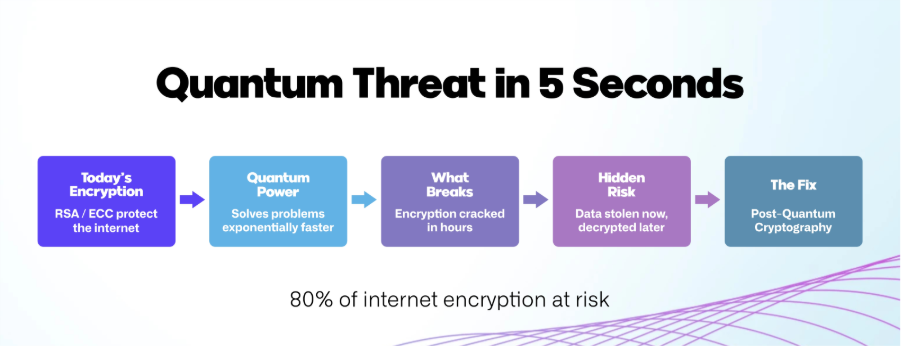
Data encryption has always stayed one step ahead of cybercriminals, until now. For decades, the cybersecurity systems safeguarding our communications, financial information, and digital identity have relied on mathematical problems that were impossible to crack using traditional computers. But with advances in quantum computing, that equation is changing entirely. A sufficiently powerful quantum machine can break widely used 2048-bit RSA encryption in just 8 hours, a task that would take classical computers billions of years. 

Thus, governments and organizations are no longer treating this situation as a “maybe.” The market for quantum-resistant systems is accelerating rapidly, with post-quantum cryptography estimated to touch $1.58 billion by 2026, growing at 49.4% CAGR through 2034. This is why quantum encryption is no longer a theoretical concept; it’s becoming a critical priority. 

The Fragile Foundation of Today’s Cryptography 

Classic cryptography is sustained on a simple but powerful assumption that some mathematical problems are too difficult to solve within any reasonable timeframe. 

This assumption underpins widely used systems such as: 

  • Rivest–Shamir–Adleman (RSA) 
  • Elliptic Curve Cryptography (ECC) 
  • Diffie-Hellman Key Exchange 

These systems rely on “one-way functions” operations that are easy to perform but extremely difficult to reverse without the correct key. For instance, multiplying two large, odd numbers is simple, but factoring the result back into those odds is computationally intensive.  In traditional computing terms, breaking RSA-2048 would require an astronomical amount of energy and time, far beyond practical limits. That’s the main reason why this algorithm has remained a global standard for securing everything from banking systems to HTTPS connections. 

However, this trust is rooted in computational limitations, not absolute security. While the rise of quantum-resistant cryptography highlights a critical truth that once those computational limits are removed, the whole security system collapses. Due to this reason, organizations are increasingly shifting towards quantum safe cryptography, not because the classical systems are broken today, but because they will be after 2030. 

What Makes Quantum Computing a Real Threat

Quantum computing represents a fundamental transition from classical computing, not just in terms of speed but in logic. Modern-day computers process information in binary bits (0s and 1s), while quantum computers use qubits, which can exist in multiple states simultaneously due to superposition. This gives quantum computers a competitive edge to evaluate many possible solutions at once. Moreover, entanglement creates correlations between qubits that maximize computational efficiency in ways traditional systems cannot replicate. 

This results in an exponential increase in computational power for specific problem types, particularly those used in cryptography. 

To put this into perspective: 

  • A classical computer tests solution sequentially 
  • A quantum computer can evaluate vast solution spaces simultaneously 

This unique capability is precisely what makes the discussion of quantum-resistant encryption urgent. It’s not about faster hacking; it’s about bypassing the assumption that makes classic encryption secure. Additionally, as quantum hardware continues to improve its error correction and stability capabilities, the gap between theoretical capability and practical application continues to shrink, bringing organizations closer to real-world quantum attacks. 

Shor’s Algorithm: The Algorithm That Breaks Everything 

This algorithm is widely seen as the single biggest threat to classic encryption systems. Developed in 1994, Shor’s Algorithm provides an effective way of factoring large integers, something that traditional computers struggle with. This directly weakens the security of RSA and other public-key systems. 

The following are top 3 reasons why it’s so powerful: 

  1. It transforms a problem considered “computationally infeasible” into a solvable one. 
  2. It scales efficiently with larger numbers, unlike classical methods. 
  3. It enables direct recovery of private keys from public keys. 

In practical terms, this means that organizations’ encrypted communications, digital signatures, and financial transactions could all be compromised in the blink of an eye. What makes this situation even worse is the “speed.” Under ideal conditions, quantum systems running Shor’s Algorithm could bypass encryption in hours instead of millennia. This is the point where conventional cryptography fails and where post-quantum encryption becomes essential for survival. 

Grover’s Algorithm: Weakening Even Strong Systems 

While Shor’s Algorithm targets asymmetric encryption, Grover’s Algorithm focuses on symmetric encryption systems like Advanced Encryption Standard (AES). Instead of breaking encryption, this method accelerates brute-force attacks. 

Here’s how: 

  • It reduces the number of operations needed to guess a key. 
  • It effectively halves the security strength of symmetric algorithms. 

For example: 

  • AES-128 becomes vulnerable at a much lower computational cost. 
  • AES-256, while still strong, loses a significant portion of its security margin. 

This means that even quantum-safe systems in the past need reassessment. Grover’s Algorithm reinforces the need for quantum-proof encryption, where security models account for quantum-backed attacks, not just traditional ones. The point to be noted here is that the quantum threat is not limited to one type of encryption; it revolves around the entire cryptographic ecosystem

The Timeline is Shorter Than Expected 

For decades, quantum threats were assumed theoretical with no practical impact. However, that narrative is rapidly changing with recent computing advancements, and it is suggested that breaking encryption may not require millions of qubits as believed previously. Instead, it’s assumed that nearly 10,000 high-quality qubits could be sufficient to break widely used cryptographic systems. This significantly accelerates the expected timeline. 

Current projections indicate: 

  • 10–15 years for large-scale, fault-tolerant quantum computers 
  • Earlier breakthroughs possible due to rapid investment and innovation 
  • Governments and private sector organizations actively racing toward quantum advantage 

The Invisible Risk: Data is Already Being Targeted 

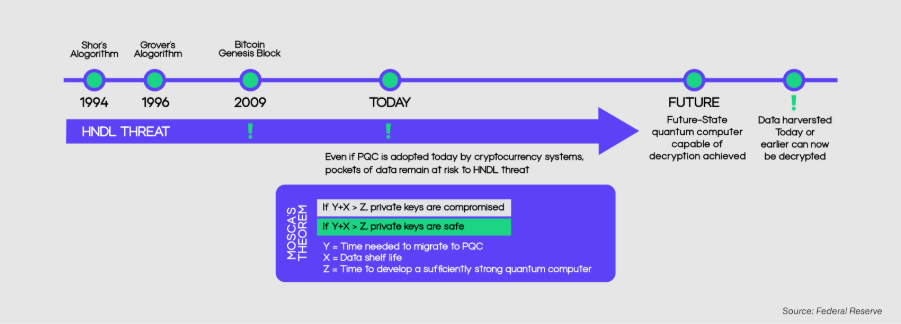
The darkest side of the quantum threat is that it does not require immediate capability to cause damage. The Harvest Now, Decrypt Later (HNDL) strategy is already in motion. Cyber attackers are intercepting encrypted data today, storing it in massive volumes, and waiting for quantum computers to unlock it in the future. This is creating a time-delayed vulnerability, as sensitive data, including financial records, healthcare information and government communications, which often retains value for years, can be transmitted securely today could be exposed in the future without any additional breach. 

This is why quantum encryption strategies must address both present and future threats. Organizations that fail to account for HNDL risks are effectively leaving a backlog of exploitable data for future attackers. 

Why This Changes Everything for Businesses

The effects of quantum decryption extend far beyond technical systems; they have implications for the entire business landscape.  

When encryption fails, it can lead to: 

  • Immediate exposure of sensitive customer data 
  • Loss of intellectual property and competitive advantage 
  • Regulatory penalties and legal consequences 
  • Long-term reputational damage 

In industries like defence, healthcare, government, and finance, the stakes are even higher, as a single quantum-backed attack could compromise decades of encrypted data in one breach. This is why organizations are shifting toward quantum-resistant cryptography as part of broader risk management and cybersecurity strategies. 

The Evolution: From Classical to Quantum Safe Encryption
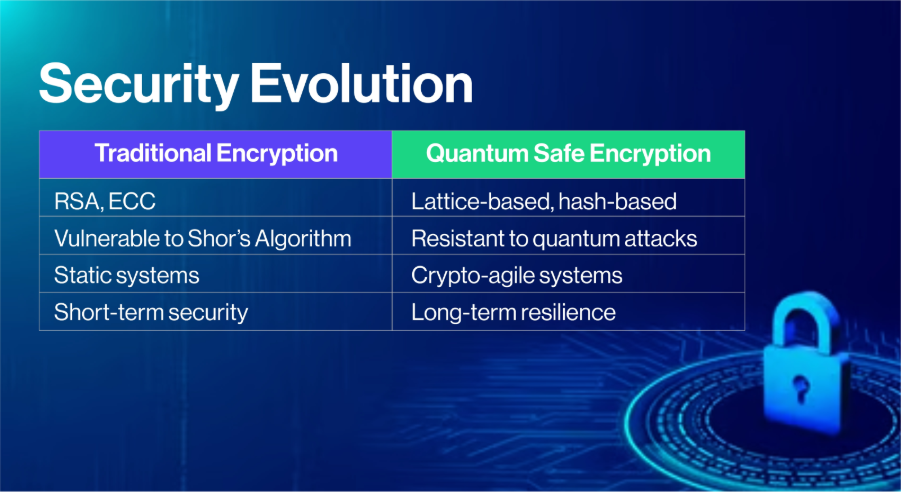
Despite the emerging risks, encryption itself is not becoming obsolete; it’s evolving. Thus, researchers are actively developing post-quantum cryptography methods designed to withstand quantum attacks, including: 

  1. Lattice-based cryptography (resistant to both classical and quantum attacks) 
  2. Hash-based cryptography (used for secure digital signatures) 
  3. Code-based cryptography (with decades of proven resilience) 

These approaches form the backbone of quantum safe cryptography. However, quantum-transitioning to these systems presents challenges: 

  • Compatibility with existing infrastructure 
  • Performance considerations at scale 
  • Long migration timelines across distributed systems 

This is why organizations must approach post-quantum encryption as a phased transformation, not a one-time upgrade. 

Why Quantum Encryption Requires a Strategic Approach

The transition to quantum-resistant systems is not just technical, it’s strategic. This means, quantum risk has unique characteristics which require tailored strategic response. 

Some of the unique characteristics, includes: 

  • It introduces delayed but irreversible exposure 
  • It affects data already in storage, not just future communications 
  • It requires long-term planning and execution 

This is why quantum-proof encryption strategies are becoming essential. A comprehensive approach includes: 

  • Crypto-agility: Ability to switch algorithms without rebuilding systems. 
  • Hybrid Encryption Models: Combining classical and post-quantum methods. 
  • Risk-based Prioritization: Protecting high-value data first. 
  • Continuous Monitoring: Adapting as quantum capabilities evolve. 

Thus, organizations that treat this as a gradual transition will be better positioned than those forced into reactive changes later. 

How QEncrypt Defines the Future of Quantum-Resistant Security 

As the shift toward quantum encryption accelerates, organizations need more than awareness; they need execution and leadership. QEncrypt is built to address this exact challenge. Rather than offering point solutions, QEncrypt provides a forward-looking framework that enables organizations to: 

  • Implement quantum resistant encryption across critical systems 
  • Transition seamlessly to post quantum cryptography 
  • Protect against Harvest Now, Decrypt Later risks 
  • Maintain long-term data security and compliance 

By combining advanced cryptographic design with real-world deployment strategies, this tool helps organizations move from reactive defence to proactive resilience. 

In a world where encryption is being redefined, QEncrypt stands at the forefront, helping define what secure means in the quantum era. 

Final Thoughts 

This is a sure thing that quantum computing will not eliminate encryption, but it will fundamentally redefine it. The systems that protect today’s digital infrastructure were designed for a world constrained by classical computing limits, and those limits are rapidly disappearing. As quantum capabilities advance, the risk will not emerge gradually, it will arrive suddenly, exposing years of previously secure data.  

Therefore, organizations that fail to act early may discover that their most valuable information has already been compromised. The transition toward quantum encryption, quantum safe encryption, and post quantum cryptography is no longer optional, it is inevitable. The organizations that succeed in this new era will be those that prepare in advance, adopt flexible security strategies, and prioritize long-term resilience over short-term convenience. 

Harvest Now, Decrypt Later: The Hidden Quantum Threat 

Password-based encryption has long been the foundation of digital trust. Every organisation operates on the belief that encryption keeps data safe, not just today, but indefinitely. But with the emergence of a new threat model, Harvest Now, Decrypt Later (HNDL), this belief is about to break. Instead of immediately manipulating encryption, cyber attackers are shifting strategies. They are gathering encrypted data today, storing it at scale, and waiting for the right moment when quantum computing advances, making decryption possible. 

This changes everything. The breach doesn’t happen when the data is decrypted, it happens the moment it is compromised. With the quantum computing market projected to reach $5.09 billion in 2026, growing at over 40% annually, the timeline for these risks is accelerating. What once felt like a distant possibility is quickly becoming an inevitable reality, forcing organizations to rethink how long their data can truly remain secure. 

What Is “Harvest Now, Decrypt Later”? 

Harvest Now, Decrypt Later is a long-term cyberattack strategy built on patience and inevitability. Instead of decrypting confidential records in real-time, a process that requires exceptional computing power, cyber attackers focus on collecting encrypted data now and decrypting it later. 

The process is straightforward but powerful: 

  1. Harvest Now: Collect encrypted data through breaches, phishing attacks, or account takeover fraud. 
  2. Store Indefinitely: Archive massive volumes of encrypted data at low cost. 
  3. Decrypt Later: Use quantum computing to decrypt the data. 

What makes this cyberattack strategy particularly dangerous is that it does not require immediate success; impostors do not need to break encryption in real-time. They only need to ensure they have loads of data until the necessary decryption tools become available. 

This fundamentally reframes encryption. It is no longer a permanent barrier that keeps data secure, but a time-bound safeguard. If the value of the data persists longer than the strength of the encryption protecting it, then the data can be exposed easily, just on a delayed timeline. 

Why This Threat Exists Today, not in the Future 

One of the biggest misconceptions about Harvest Now, Decrypt Later is the belief that it’s a future problem closely linked with the arrival of quantum computers. However, the truth is, this threat is already active as data harvesting is happening now. 

Some of the few categories of sensitive data are inherently long-lived: 

  • Medical and genetic records may remain relevant for a lifetime. 
  • Financial and legal records often require decades of confidentiality. 
  • Government and defence communications may need to remain secret indefinitely. 
  • Intellectual property can retain value for decades. 

Thus, it’s evident that current pre-quantum encryption algorithms securing organizational data, such as Rivest-Shamir-Adleman (RSA) and Elliptic Curve Cryptography (ECC), are not powerful enough to resist quantum attacks. Once quantum computers reach a sufficiently advanced stage, these widely used systems could become obsolete. Therefore, with growing awareness of Harvest Now, Decrypt Later, it has been found that almost 60% of businesses now view HNDL as a major threat, particularly for information having value beyond 2030. 

How the HNDL Attack Actually Works 

Despite its long-term implications, the mechanics of HNDL are relatively simple and rely heavily on existing cyberattack methods. The following is an example of how this attack works. 

Data Harvesting 

The first stage involves gathering encrypted data from as many sources as possible. This can include: 

  • Intercepting encrypted internet traffic 
  • Breaching cloud storage or enterprise databases 
  • Accessing backups or archives 
  • Exploiting vulnerabilities in third-party systems 

The thing to be noted here is that attackers are not trying to decrypt anything at this stage. They are simply stockpiling valuable data. 

Silent Data Storage 

Once data is collected, it is stored for future use. Advances in storage technology have made it easy to maintain large datasets for long periods at a very cheap cost, allowing attackers or well-funded groups to build extensive archives of encrypted information. 

This stage is completely invisible. Organizations have no practical way of knowing that their encrypted data has been copied and stored elsewhere. 

Future Decryption 

The final stage occurs when technology catches up. With the development of Cryptographically Relevant Quantum Computers (CRQCs), cyber attackers can apply algorithms like Shor’s to break encryption schemes that are currently considered secure. At that point, previously inaccessible data becomes fully readable. 

Which Industries are Most at Risk? 

HNDL is not about opportunistic attacks, it is about strategic data collection. As a result, attackers prioritize data that will retain value over long periods. 

The most at-risk sectors include: 

  • Financial Services: Transaction histories, banking data, contracts 
  • Healthcare: Patient records, genomic data, research 
  • Government and Defence: Classified communications and intelligence 
  • Technology and R&D: Patents, proprietary algorithms, product designs 

The stakes are enormous. According to recent economic analysis, a single quantum-enabled breach affecting a major financial institution in the United States could result in $2.0 to $3.3 trillion in damages. This highlights why HNDL is not just a cybersecurity issue, it is a systemic economic risk which can only be secured using quantum proof encryption methods. 

Q-Day: The Role of Quantum Computing 

Quantum computers are the key technological driver behind HNDL. Unlike traditional computers, quantum systems can solve big mathematical problems at an exponential speed, particularly those algorithms underlying classical encryption. Q-Day generally refers to the point at which quantum computers will become capable of manipulating widely used cryptographic algorithms at scale. While the exact timelines are uncertain, tech industry leaders and governments are already preparing for a transition window between 2030 and 2035. 

Key milestones include: 

  • 2030: Deprecation of legacy encryption algorithms like RSA and ECC 
  • 2035: Full transition to quantum-resistant cryptography for federal systems 

However, this timeline is not speculative planning; it is an active, global effort to prepare for a known disruption. This is why it’s estimated that the Post-Quantum Cryptography (PQC) market is projected to grow from $1.35 billion (2025) to $22.68 billion by 2033. 

The Real Risk: Time-Delayed Breaches 

HNDL has emerged as a new type of cybersecurity risk; data breaches remain invisible until it’s too late. 

Traditional breaches are immediate and reactive: 

  • Systems are compromised 
  • Alerts are triggered 
  • Responses are initiated 

While HNDL operates on a delayed timeline: 

  • Data is stolen silently 
  • No alerts are generated 
  • Impact will be visible after years or decades 

Thus, HNDL issue creates significant challenges: 

  • Organizations cannot respond to a breach they don’t know occurred. 
  • Cybersecurity systems are not designed for delayed exposure. 
  • Sensitive information may be circulating publicly while assuming it’s stored safely. 

The thing to be considered here is that this systemically engineered cyberattack strategy is particularly dangerous from both regulatory and technical perspective. 

Rethinking Security: From Strength to Longevity 

The technological shifts in cyberattack techniques and the emergence of Harvest Now, Decrypt Later are forcing organizations to rethink their encryption protocols. For decades, the focus has been on strength, choosing fool-proof algorithms that are difficult to break, but HNDL introduces a new requirement: Longevity. 

Organizations must now evaluate: 

  • How long do they need to store confidential data 
  • Whether current encryption and cybersecurity measures can help them secure confidential data 
  • How quickly can they adapt to new cybersecurity protocols 

How to Defend Against HNDL 

Addressing and combating HNDL requires a proactive and strategic approach. Waiting for quantum computers to arrive is not an option. The following are the critical steps that are not just defensive but are essential for developing future-ready cybersecurity architectures: 

1. Identify Long-Term Sensitive Data: Understand which data assets require long-term confidentiality and prioritize them for enhanced protection. 

2. Adopt Post-Quantum Cryptography (PQC): Begin transitioning toward quantum-resistant algorithms that can withstand future attacks. 

3. Build Crypto-Agile Infrastructure: Ensure systems can quickly adapt to new cryptographic standards without major disruption. 

4. Reduce Data Retention: Limit how long sensitive data is stored. Reducing exposure reduces risk. 

5. Secure Data Across Its Lifecycle: Protect data in transit, at rest, and during processing to minimize interception opportunities. 

The Road Ahead and Where QEncrypt Fits In 

Harvest Now, Decrypt Later is more than just a new cyber-attack strategy, it represents a fundamental shift in how organizations must understand and manage data security risk. One thing is clear: HNDL highlights a critical truth that cybersecurity decisions made today will determine whether confidential information remains secure years from now. This makes the adoption of post-quantum encryption not just a future upgrade, but an immediate necessity. As the world approaches the 2030–2035 quantum transition window, organizations face a rapidly narrowing opportunity to act. 

This is where platforms like QEncrypt become essential. The next generation of cybersecurity is not just about reacting to threats but anticipating them. QEncrypt is built around this principle, enabling organizations to move toward quantum-resilient encryption, crypto-agility, and long-term data protection strategies that align with the realities of HNDL. 

Rather than treating encryption as a static solution, this tool helps organizations rethink it as an evolving system. Because in a world where attackers are already harvesting encrypted data, the real measure of security is not whether your data is protected today. But whether it will still be protected when the future arrives. 

Application Encryption: How QEncrypt Secures Modern Software Data 

Modern applications are the backbone of today’s digital economy, powering everything from banking systems and healthcare platforms to SaaS products and enterprise infrastructure. Every interaction within these systems generates, processes, and stores highly sensitive data, and protecting this data is no longer optional; it is a critical business requirement. 

However, the cybersecurity landscape is rapidly evolving. Traditional encryption methods that once provided strong protection are now facing increasing pressure from advanced cyberattacks and the imminent rise of quantum computing. These emerging technologies have the potential to break widely used cryptographic systems, putting long-term data security at serious risk. 

This is where QEncrypt steps in. By leveraging post-quantum cryptography and quantum-safe encryption, QEncrypt is built to secure application data not only for today’s threats but for the challenges of tomorrow. 

Modern Applications Handle High-Value, Long-Life Data 

Today’s applications operate in highly dynamic and distributed environments. Data flows continuously between cloud servers, APIs, mobile devices, and third-party integrations. This constant movement significantly increases the attack surface, making applications a prime target for cybercriminals. 

What makes the challenge even more complex is the long lifespan of sensitive data. Financial records, healthcare data, legal documents, and proprietary business information often need to remain secure for years, or even decades. A breach today could have consequences far into the future. 

Additionally, modern applications must handle: 

  • Real-time transactions across global networks 
  • Multi-user access environments 
  • High-volume data processing at scale 
  • Integration with external systems and services 

Without strong encryption at every layer, this data becomes vulnerable to interception, leakage, and unauthorized access. 

The Shift to Post-Quantum and Quantum-Safe Encryption 

The cybersecurity industry is undergoing a major transformation as it prepares for the post-quantum era. Traditional encryption systems are being reevaluated, and new approaches are emerging to address future risks. 

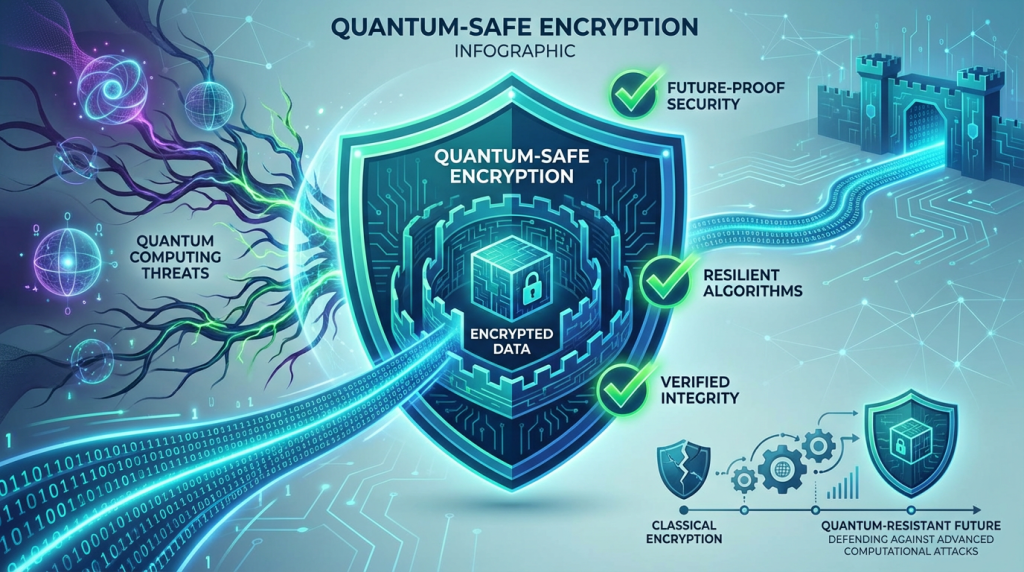
Post-quantum cryptography is specifically designed to resist attacks from both classical and quantum computers. Unlike legacy systems, these cryptographic methods are built on mathematical problems that remain difficult to solve, even for quantum machines. 

Quantum-safe encryption takes this a step further by ensuring that data encrypted today will remain secure in the future, even if intercepted and stored by attackers. 

QEncrypt integrates these advanced approaches into a unified framework, enabling organizations to transition seamlessly into next-generation security without disrupting existing systems. This proactive approach ensures long-term resilience in an increasingly uncertain threat landscape. 

Why Application Encryption Is Mission-Critical

Application encryption plays a foundational role in protecting digital systems. Without it, sensitive data becomes exposed at multiple points, during transmission, processing, and storage. 

As cyberattacks grow more sophisticated, attackers are increasingly targeting application-layer vulnerabilities. This includes exploiting weak encryption, misconfigured systems, and insecure APIs. 

Encryption is essential because it: 

  • Protects sensitive user and financial data from unauthorized access 
  • Ensures compliance with global data protection regulations 
  • Maintains trust between businesses and their users 
  • Prevents data breaches and costly security incidents 
  • Safeguards long-term data confidentiality 

Even if attackers gain access to encrypted data, strong encryption ensures that the information remains unreadable and unusable without the correct decryption keys. 

For modern organizations, encryption is not just a technical feature, it is a strategic necessity. 

The Evolution of Application Encryption 

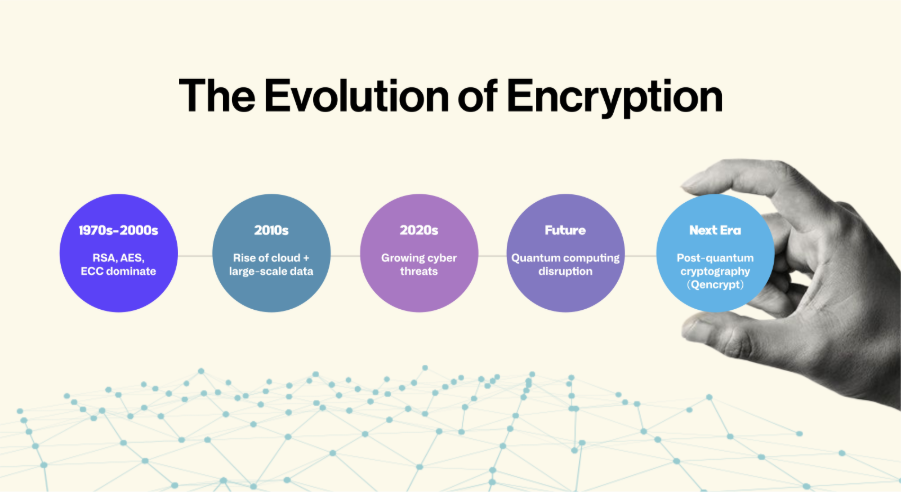
Encryption has come a long way from its early implementations. For decades, algorithms such as RSA, ECC and AES have been the foundation of digital security. These systems rely on mathematical complexity to prevent unauthorized decryption.

However, as computing power increases, the assumptions underlying these algorithms are being challenged. This has led to the development of new cryptographic techniques designed for the future. 

Key innovations include: 

  • Quantum-resistant algorithms that withstand advanced computational attacks. 
  • NIST-standardized frameworks guiding the future of encryption. 
  • Lattice-based cryptography, offering strong security with scalable performance. 
  • Quantum Key Distribution (QKD) for ultra-secure key exchange mechanisms. 

These advancements mark a shift toward encryption systems that are not only secure today but also resilient against tomorrow’s technologies.

How Quantum Computing Changes the Encryption Landscape 

Quantum computing represents one of the most significant technological shifts in modern history. By leveraging qubits, quantum computers can process vast amounts of information simultaneously, solving problems that are practically impossible for classical systems. 

While this brings enormous potential for innovation, it also introduces serious risks for cybersecurity. Many existing encryption systems rely on mathematical problems that quantum computers could solve efficiently. 

The implications are profound: 

  • Public-key encryption systems like RSA and ECC could become obsolete 
  • Encrypted data stored today could be decrypted in the future 
  • Secure communications could be compromised 
  • Digital authentication systems could be weakened 

This has given rise to the concept of “Harvest Now, Decrypt Later”, where attackers collect encrypted data today with the intention of decrypting it once quantum capabilities mature. 

Organizations must act now to mitigate these risks and ensure long-term data protection.

Why QEncrypt Delivers Next-Generation Application Encryption 

QEncrypt is purpose-built to address the challenges of modern and future cybersecurity. Unlike traditional encryption solutions, it is designed with a forward-looking architecture that prioritizes long-term resilience. 

At its core, QEncrypt integrates post-quantum cryptography with practical implementation strategies, enabling organizations to adopt advanced security without complexity. 

Key differentiators include: 

  • A strong foundation in quantum-safe cryptographic principles 
  • Use of advanced algorithms resistant to emerging attack methods 
  • Alignment with global standards and evolving security frameworks 
  • Scalable architecture suitable for modern applications 

By combining innovation with usability, QEncrypt ensures that organizations can secure their applications without sacrificing performance or flexibility. 

Key Features of QEncrypt for Application Security 

QEncrypt offers a comprehensive set of features designed to protect application data at every stage of its lifecycle. 

  1. Quantum-Safe Encryption: Implements fool-proof encryption techniques designed to remain secure against future quantum threats. 
  2. Post-Quantum Cryptography Support: Ensures compatibility with next-generation cryptographic standards and frameworks. 
  1. Secure Local Encryption: Encrypts data directly on the user’s device, minimizing exposure and reducing risk. 
  1. Long-Term Data Protection: Protects stored data from future decryption attempts, ensuring lasting confidentiality. 
  2. Advanced Mathematical Security: Utilizes robust cryptographic models, including lattice-based approaches, to strengthen security. 
  3. Future-Ready Architecture: Designed to evolve alongside emerging standards, ensuring continued relevance and protection. 

Industries That Rely on Application Encryption 

Application encryption is critical across industries where data sensitivity and regulatory requirements are high. 

  • Financial Services rely on encryption to secure transactions, prevent fraud, and protect customer data. 
  • Healthcare Organizations must safeguard patient records and comply with strict privacy regulations. 
  • Government and Defence sectors require long-term protection for classified and sensitive information. 
  • Technology Companies depend on encryption to protect intellectual property, source code, and innovation pipelines. 
  • Legal and Compliance Teams need secure systems to maintain confidentiality of legal documents and communications. 

QEncrypt provides a flexible solution that adapts to the unique security requirements of each industry. 

The Future of Application Encryption

The shift toward quantum-resistant encryption is already in motion. Governments, enterprises, and research institutions are investing heavily in next-generation cybersecurity solutions. 

Key developments shaping the future include: 

  • Standardization of post-quantum cryptographic algorithms 
  • Increased adoption of quantum-safe encryption frameworks 
  • Advancements in secure communication technologies 
  • Greater emphasis on long-term data protection strategies 

Organizations that begin this transition early will be better positioned to handle future threats and maintain trust in an increasingly digital worlds of and so keep safe, details that are important to all of these types of business.

Final Thoughts 

The future of cybersecurity depends on how well organizations prepare today. As digital systems grow more complex and cyber threats become more advanced, the limitations of traditional encryption are becoming increasingly clear. The rise of quantum computing adds urgency to this challenge, introducing risks that cannot be addressed with legacy approaches alone. 

Application encryption must evolve to meet these demands, shifting from short-term protection to long-term resilience. This is where QEncrypt delivers real value. By combining post-quantum cryptography, quantum-resistant algorithms, and a future-ready architecture, it provides a comprehensive solution for securing modern application data. 

For businesses, developers, and enterprises handling sensitive information, adopting quantum-safe encryption is no longer a forward-thinking option; it is a necessity. QEncrypt offers a reliable, scalable, and future-proof path to protecting data in the next era of cybersecurity. 

[Secure Your Future] 

Quantum Safe Encryption: Solving the Security Problems Traditional Encryption Can’t

Regarding encryption, a lot of people assume a file is secure as soon as it is encrypted – but sadly, this isn’t actually true. Still, encryption – being technology – does degrade with time, and the ways we presently protect information weren’t made to withstand the increasing processing strength we’ll have in the future. Because of this, quantum-resistant encryption is now part of what modern cybersecurity planning includes.

The core difficulty is the difference between how long we want to keep encrypted data, and how long the encryption we’re using will remain secure. We can’t be surprised by upcoming cyber attacks, and so, both companies and individuals are now thinking about encryption from a long-range viewpoint.

This post really investigates the security difficulties we have at the moment and shows how quantum-proof encryption, and things like QEncrypt, are solving these issues in a very sensible, practical manner.

The Hidden Frustration with Modern Encryption

The true trouble isn’t a shortage of resources; it’s putting too much trust in how long those resources will work. Quantum-resistant encryption operates on the idea that data security ought to cover the entire period the information exists, and employs a different sort of technology – things like QEncrypt – to allow groups and people to feel secure.

Data That Outlives Its Encryption

Files aren’t likely to be needed briefly. Things like significant paperwork, agreements, patents, health information, money matters and secret exchanges must be safeguarded for a long time – possibly for many years, even tens of years. Ordinary encryption doesn’t allow for this, and won’t deal with the problem of risk over a long period. Quantum-proof encryption was created to meet this demand, making sure that your files will not become impossible to read as the ability of computers improves in the future.

“Harvest Now, Decrypt Later” Is No Longer Theoretical

A worry, too, is the tactic often called “harvest now, decrypt later” doesn’t seem so unlikely as it once did. Because people are anticipating the time quantum computers arrive – ones that can decrypt things – hackers who want to break through encryption can gather and keep hold of data which is encrypted.
Threats, and quite famous ones at that, aim at data that is stored, back-ups, and archives; and it is these that companies and other groups think are securely shut away, though quantum-safe encryption solves this problem by making use of methods of encryption that will withstand both the ways of decryption which exist today and the ways which will be around in the future.

Traditional Encryption Wasn’t Built for Quantum Reality 

RSA and ECC remain useful, though they weren’t at the start built to hold up against quantum computing attacks – and quantum computers, with their far better ability, will entirely overcome them. It isn’t a question of abandoning systems that have worked, however; instead we must accept that encryption which will be good for the future needs to be created anew, to deal with dangers at the quantum scale. Accepting this is a stage in the development of encryption, not something unusual, and is at the moment how we’re shaping new, present-day encryption norms.

Security Tools Are Too Complex to Use Consistently 

A really big issue in cybersecurity, as well, is how easy – or not easy – systems are to work with. Quite a lot of secure setups don’t function because they’re just too hard to get going, to oversee, or to regularly employ. If encryption programs are too complex, individuals will either avoid them or get them wrong. Quantum-proof encryption can work, however, if it’s direct, dependable, and uncomplicated enough to be used, and a great many of the concepts around it aren’t like that.

Future-Proofing Feels Disruptive and Expensive 

Lots of organisations hesitate to adopt new encryption standards because they worry about the cost, disruption, and hassle, but replacing infrastructure, training their staff, and migrating their data feels like a monumental task that they can put off until the last minute, which they usually do.  

Newer quantum safe encryption solutions are designed to slot into place, rather than tearing down what’s already there, and by getting started early, companies can greatly reduce the costs, knock out the need for future migrations, and spread the risk out over time.   

How Quantum Safe Encryption Solves These Challenges

When it comes to cybersecurity, traditional encryption has three main challenges:

  1. Data will eventually become outdated
  2. It’s susceptible to future decryption methods
  3. Impractical to implement in real-world systems

But quantum safe encryption addresses all of these issues, and it provides you with:

  • Long-term protection
  • Resilient to potential decryption
  • Easy to integrate into any system

This switch from a reactive to a proactive mindset allows you to safeguard both the data you already have and the risks that will come in the future.

How QEncrypt Makes Quantum Proof Encryption Practical

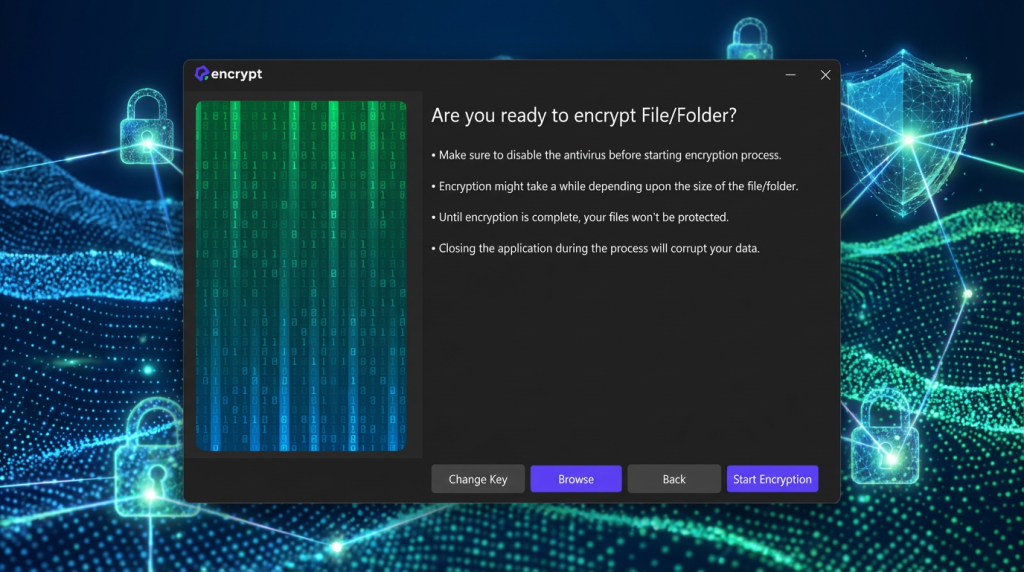
QEncrypt makes quantum-resistant encryption practical – offering a file security system people can use, and which doesn’t demand a lot of understanding of cryptography to actually encrypt and safeguard private papers. Rooted in ease, and with a view to working with what’s already there, and a pledge to be secure for years ahead, QEncrypt joins up involved encryption and routine data security.

Who Should Adopt Quantum Proof Encryption Now? 

This isn’t just for corporations and governments anymore; quantum proof encryption is becoming necessary for the following: 

  • Any business that has confidential files 
  • Professionals who store client info 
  • Companies that have to keep records for a long time  
  • Individuals who are serious about their privacy and long-term security 

Those who adopt it now will have a much smoother ride, whereas those who don’t will face costly and rushed migrations. 

Why Acting Early Matters More Than Waiting 

Those in the know – leading specialists – are warning that a poor plan is to put off altering your encryption until quantum computing is widely available; should criminals learn of the weaknesses, the expense of fixing the problems will greatly increase, and, on reflection, there isn’t a single solid reason not to use quantum-resistant encryption now.

More Value, Less Complexity: QEncrypt in the MindSuite Bundle 

Assessing long-term security for your computer, buying QEncrypt as part of the MindSuite software bundle is not only cost-effective, but also provides you with clear financial savings.  

  • Coming in at $205.95 per year when bought separately, the cost of the included products escalates to $617.85 over the course of three years.  
  • Whereas, the MindSuite bundle that comes with QEncrypt can be had for $174.99 per year and $448.99 over three years, with the same quantum-safe encryption features thrown in for the price.  

In addition to the price savings, the M

Conclusion:

When we talk about encryption, security isn’t only for protecting information as it stands – it’s about being certain that protection will continue. Quantum-safe encryption – which people also call post-quantum encryption – strengthens the usual security we have, and answers worries about how long data will stay safe, how easy it is to use in practice, and what problems may come up later. Well-known programs like QEncrypt allow us to start using security which resists quantum computers, and lets people and companies be comfortable with protecting important data, not only at this moment, but for a long time to come.

Quantum-Safe Cryptography: Securing Data in the Quantum Era 

The digital world runs on trust, and that trust is built on encryption. Every financial transaction, private message, and sensitive business operation relies on cryptographic systems designed to keep data secure. However, a technological shift is approaching that threatens to break this foundation entirely: quantum computing. Unlike classical computers, quantum machines can process complex mathematical problems at unprecedented speeds, potentially rendering today’s encryption methods obsolete. Industry forecasts suggest that the global Post-Quantum Cryptography (PQC) market size is forecasted to grow remarkably from $0.42 billion in 2025 to $2.84 billion by 2030, at a CAGR of 46.2%, as organizations race to prepare.  

This isn’t just a theoretical risk; it’s a strategic cybersecurity challenge unfolding now. To safeguard long-term data integrity and privacy, businesses and governments must begin transitioning toward quantum-safe cryptographic systems today, before existing protections fail. 

What Is Post-Quantum Cryptography (PQC)? 

PQC is a specialized field focused on developing encryption methods that remain secure against both classical and quantum computing attacks. Traditional cryptographic systems rely on mathematical problems that are computationally infeasible for classical computers to solve within a reasonable timeframe. However, quantum algorithms fundamentally change this assumption. 

For instance, widely used encryption standards such as Rivest-Shamir-Adleman (RSA) and Elliptic Curve Cryptography (ECC) depend on the difficulty of factoring large numbers or solving discrete logarithms. Classical computers would take millions or even billions of years to solve these problems. But with quantum algorithms like Shor’s Algorithm, these same problems can potentially be solved in a matter of hours or even seconds. 

This creates a critical vulnerability in modern cybersecurity infrastructure; even systems that are considered secure today could become easily breakable once sufficiently powerful quantum computers are developed. Importantly, not all cryptographic methods are equally vulnerable. Symmetric encryption algorithms like AES are more resistant to quantum attacks. While Grover’s Algorithm can reduce their effective security strength, this can be mitigated by doubling key sizes, for example, moving from AES-128 to AES-256. 

Thus, PQC aims to replace vulnerable systems with algorithms based on mathematical problems that remain difficult even for quantum computers, ensuring long-term data protection. 

Why Quantum-Resistant Encryption Matters Now

The urgency around quantum-safe encryption is driven by both technological progress and emerging attack strategies. One of the most concerning threats is known as “Harvest Now, Decrypt Later” (HNDL). In this scenario, attackers intercept and store encrypted data today with the intention of decrypting it in the future when quantum computing capabilities become available. This is particularly dangerous for data that must remain confidential for long periods, such as: 

  • Financial records 
  • Government communications 
  • Healthcare data 
  • Intellectual property 

Even if quantum computers capable of breaking encryption are 10–15 years away, the data being transmitted today may still hold value decades into the future. This makes current encryption practices insufficient for long-term security. 

Governments and regulatory bodies are already recognizing this risk. The U.S. National Institute of Standards and Technology (NIST) initiated its PQC standardization process in 2016, signaling early awareness of the quantum threat. Organizations that delay adopting quantum-safe strategies risk exposing themselves to future breaches, regulatory penalties, and loss of trust. 

Core Quantum-Safe Cryptographic Approaches 

To address quantum-era threats, researchers have developed several categories of quantum-resistant algorithms. Each approach is based on different mathematical principles and comes with unique advantages and trade-offs. 

  • Lattice-Based Cryptography 

Lattice-based cryptography is widely considered the most promising solution for post-quantum security. It relies on the complexity of problems defined within high-dimensional lattice structures, such as the Learning With Errors (LWE) problem and the Short Integer Solution (SIS) problem. 

These problems are computationally difficult to solve, even for quantum computers, making them strong solutions for future encryption systems. Lattice-based methods are also highly versatile, supporting encryption, digital signatures, and key exchange protocols. However, they often require larger key sizes and increased computational resources, which can impact system performance. 

  • Hash-Based Cryptography 

This type of encryption uses cryptographic hash functions to create secure digital signatures. Unlike other methods, it does not rely on algebraic structures that could be vulnerable to quantum attacks. This approach is well-understood and has been studied extensively, making it a highly trusted option for specific use cases, particularly digital signatures. 

The primary drawback is that hash-based signatures tend to be larger in size and may have limitations in terms of scalability and repeated usage. 

  • Multivariate Cryptography 

Multivariate cryptography is based on solving systems of multivariate polynomial equations, which are extremely difficult to compute efficiently. This complexity provides strong resistance against both classical and quantum attacks. These systems are particularly useful for digital signature schemes. However, they often suffer from large public key sizes and practical implementation challenges, which can limit their adoption in real-world applications

The Role of NIST in Standardization

The National Institute of Standards and Technology (NIST) has played a central role in guiding the transition to quantum-safe cryptography. Its multi-year evaluation process brought together experts from academia, industry, and government to rigorously test and validate proposed algorithms. After several rounds of analysis, NIST announced its first set of standardized PQC algorithms in 2024. These include CRYSTALS-Kyber for key encapsulation and CRYSTALS-Dilithium for digital signatures

This standardization process is critical because it ensures that: 

  1. Cryptographic algorithms are secure and reliable 
  1. Systems can interoperate globally 
  1. Organizations can adopt solutions with confidence 

NIST’s approach emphasizes transparency, peer review, and real-world applicability, making its standards a cornerstone of global cybersecurity strategy. 

PQC Adoption: Addressing Real-World Challenges 

Despite the clear need for quantum-safe cryptography, implementation presents several challenges. Organizations must navigate technical, operational, and strategic complexities when transitioning from legacy systems. 

One major issue is integration. Existing infrastructure was not designed with PQC in mind, making it difficult to retrofit new algorithms without significant changes. Additionally, quantum-safe algorithms often require more computational power, leading to performance trade-offs. 

Another challenge is the need for crypto-agility, the ability to quickly switch between cryptographic algorithms as new standards emerge or threats evolve. Without this flexibility, systems risk becoming outdated or vulnerable. There is also a shortage of skilled professionals with expertise in post-quantum cryptography, which can slow adoption and increase implementation risks. To overcome these challenges, organizations must take a proactive and strategic approach, starting with risk assessments and pilot implementations. 

Lattice-Based Cryptography: The Front Runner 

Among all PQC approaches, lattice-based cryptography has emerged as the leading candidate for widespread adoption. Its strong theoretical foundation, combined with practical performance characteristics, makes it suitable for real-world deployment. The Learning With Errors (LWE) problem, a core component of lattice-based systems, introduces controlled randomness into equations, making them extremely difficult to reverse-engineer. This property provides robust protection against both classical and quantum attacks. These algorithms have already been selected by NIST and are being integrated into modern security protocols. Their flexibility allows them to be used across a wide range of applications, from secure communications to cloud infrastructure. 

As organizations begin transitioning to quantum-safe systems, lattice-based cryptography is expected to play a central role in shaping the future of encryption.

Preparing for a Quantum-Safe Future

Transitioning to quantum-safe cryptography requires careful planning and long-term commitment. Organizations should begin by identifying critical data assets and assessing their exposure to quantum risks. 

Key steps include: 

  • Conducting cryptographic audits 
  • Prioritizing long-term sensitive data 
  • Implementing hybrid encryption models 
  • Aligning with NIST standards 
  • Building crypto-agile systems 

Early adoption not only reduces future risk but also provides a competitive advantage in industries where data security is paramount. 

Are You Prepared for the Future?

Quantum computing represents both an extraordinary technological breakthrough and a profound cybersecurity challenge. As the ability to break traditional encryption becomes increasingly realistic, the need for quantum-safe cryptography grows more urgent. Post-quantum solutions, built on advanced mathematical foundations and validated through global standardization efforts, offer a clear path forward. However, the transition is complex and requires immediate action, strategic planning, and continuous adaptation. This is where tools like QEncrypt have emerged, aiming to help organizations dealing with sensitive data prepare today to fight the quantum-era security risks. 

Organizations that invest in quantum-resistant security today will be better positioned to protect sensitive data, maintain regulatory compliance, and preserve customer trust in the years ahead. In a world where data is one of the most valuable assets, preparing for the quantum era is not just a technical necessity; it is a business imperative that will define long-term resilience and security.  

Want to secure your business data from quantum-era cyberattacks?

[Get a Free 14-day Trial] 

Quantum Encryption: Future of Secure Cybersecurity Systems 

The rapid evolution of digital infrastructure has made data security one of the most pressing priorities for organizations and governments worldwide. As reliance on cloud computing, connected devices, and digital transactions increases, so does exposure to cyber threats. At the same time, a transformative technology, quantum computing, is emerging, promising unprecedented computational power.  

While this advancement brings significant opportunities, it also introduces serious risks to existing encryption systems. According to the World Economic Forum, nearly 20 billion devices are currently connected globally, creating an expansive and vulnerable digital ecosystem. Furthermore, IBM research suggests that future quantum computers may eventually break widely used encryption standards such as RSA.  

Consequently, cybersecurity strategies must evolve. This shift is driving the development of quantum-resistant technologies designed to protect sensitive data and ensure long-term trust in digital systems. 

Understanding Quantum Key Distribution (QKD) 

To begin with, Quantum Key Distribution (QKD) introduces a fundamentally new approach to secure communication. Instead of relying on mathematical complexity, it uses the principles of quantum physics to secure data exchange. 

This distinction is important. Traditional encryption assumes that certain problems are difficult to solve. QKD, however, ensures that breaking encryption would require violating the laws of physics themselves. 

Key Principles Behind QKD 

  • Quantum Entanglement 

Particles become linked in such a way that the state of one directly influences the other. This connection remains intact regardless of distance, enabling synchronized key exchange. 

  • Quantum No-Cloning Theorem 

Quantum states cannot be copied without altering their structure. This prevents attackers from duplicating encryption keys without detection. 

  • Measurement-Disturbance Principle 

Any observation of a quantum system changes its state. As a result, interception attempts introduce detectable anomalies. 

Why QKD Matters

Because of these principles, QKD offers a level of transparency that traditional systems cannot provide. 

  • Real-time detection of unauthorized access 
  • Elimination of silent interception risks 
  • Stronger trust in communication channels 

Moreover, QKD is particularly valuable for sectors where data confidentiality is critical, such as finance, healthcare, and national infrastructure. As cyber threats grow more advanced, this level of protection becomes increasingly necessary. 

The Rise of Quantum-Safe Encryption 

While QKD provides exceptional security, it is not always practical for widespread deployment. Therefore, quantum-safe encryption has emerged as a complementary solution. 

This approach focuses on designing cryptographic algorithms that remain secure even in the presence of quantum computers. 

The Problem with Current Encryption 

Most existing systems rely on mathematical challenges that are difficult for classical computers but manageable for quantum machines. 

These include: 

  1. Factoring large numbers 
  1. Solving discrete logarithm problems 

Quantum algorithms, particularly Shor’s algorithm, can solve these efficiently. As a result, widely used encryption methods could become vulnerable in the future. 

Post-Quantum Solutions :

To address this challenge, researchers are developing alternative cryptographic approaches: 

  • Lattice-based cryptography: Uses complex geometric structures that remain difficult to solve 
  • Hash-based cryptography: Relies on one-way functions for secure authentication 
  • Code-based cryptography: Built on error-correcting codes resistant to decoding attacks 
  • Multivariate cryptography: Based on solving systems of nonlinear equations 

Each method offers a different balance between security, efficiency, and scalability. 

Transition Strategies 

Organizations are taking a phased approach to adoption. 

  1. Gradual integration of quantum-safe algorithms 
  1. Use of hybrid encryption systems 
  1. Continuous evaluation of security risks 

This ensures that current systems remain secure while preparing for future threats. 

Industry Progress and Innovation 

The advancement of quantum encryption is no longer theoretical. It is actively being developed and tested across multiple sectors. Organizations are investing in research to ensure that these technologies can operate effectively in real-world environments. 

Key Areas of Progress 

  • Expansion of secure communication networks 
  • Development of scalable encryption frameworks 
  • Integration with cloud and enterprise systems 

In addition, governments and regulatory bodies are supporting research initiatives to accelerate adoption. This collaborative effort is essential for building a secure digital future.

Market Growth Insights 

The growing importance of quantum cybersecurity is reflected in market trends: 

  • Increasing investment in quantum technologies 
  • Rising demand for advanced encryption solutions 
  • Expansion of global cybersecurity frameworks 

These trends indicate that quantum encryption is becoming a central component of modern digital security strategies. 

Post-Quantum Cryptographic Algorithms 

Post-quantum cryptographic algorithms are critical for ensuring long-term data protection. Unlike QKD, these algorithms can be implemented within existing digital systems. The following are the leading algorithm types: 

  • Lattice-Based Cryptography: Provides strong resistance against both classical and quantum attacks. 
  • Hash-Based Cryptography: Offers reliable digital signature mechanisms. 
  • Code-Based Cryptography: Ensures security through decoding complexity. 

Multivariate Cryptography: Relies on solving complex polynomial equations. 

Why These Algorithms Matter 

These algorithms are designed with future threats in mind. They can: 

  1. Protect against quantum decryption capabilities 
  2. Maintain compatibility with current systems 
  3. Support scalable implementation across industries 

Standardization Efforts 

Global standardization is a key step toward adoption, which includes: 

  1. Development of universally accepted algorithms 
  1. Rigorous testing for security and performance 
  1. Collaboration between academic and industry experts 

These efforts are helping create a stable foundation for next-generation cybersecurity. 

Implementing Quantum-Resistant Security 

Adopting quantum-safe solutions requires careful planning. Organizations must balance innovation with operational stability. 

The following are the key implementation steps that the organization must meet during the transition phase: 

  1. Risk Assessment: Identify critical assets and vulnerabilities 
  1. Hybrid Encryption Deployment: Combine traditional and quantum-safe methods 
  1. Infrastructure Modernization: Upgrade systems to support new standards 
  1. Workforce Development: Train teams to manage advanced security technologies 

Practical Considerations 

Organizations that take a proactive approach will be better prepared for future challenges. 

  • Ensuring system compatibility 
  • Managing implementation costs 
  • Maintaining performance efficiency 

Top 5 Challenges in Implementing Quantum-Safe Encryption Systems 

Despite its advantages, quantum cybersecurity presents several challenges that must be addressed. However, addressing these challenges requires ongoing investment and strategic planning.  

Some of the critical challenges are: 

  • Integration Complexity: Transitioning from legacy systems requires significant effort 
  • Performance Demands: Some algorithms require additional computational resources 
  • Evolving Standards: Continuous updates are necessary as the field develops 
  • Emerging Risks 
  • Harvest Now, Decrypt Later: Data captured today may be decrypted in the future 
  • Long-Term Data Exposure: Sensitive information remains vulnerable over time

The Future of Quantum Cybersecurity 

Looking ahead, quantum cybersecurity will play a central role in digital transformation. As quantum computing advances, the need for robust security solutions will continue to grow. 

Key Trends 

  • Increased global investment in quantum technologies 
  • Stronger collaboration between industries 
  • Accelerated development of secure communication systems 

Strategic Priorities 

Organizations should focus on: 

  • Building resilient security frameworks 
  • Ensuring long-term data protection 
  • Adapting to evolving technological landscapes 

The ability to anticipate and respond to these changes will define future success. 

Final Thoughts 

The emergence of quantum computing is reshaping the cybersecurity landscape, introducing both unprecedented risks and transformative opportunities. As traditional encryption methods face the possibility of becoming obsolete, the adoption of quantum-safe technologies is becoming increasingly urgent. Quantum key distribution and post-quantum cryptographic algorithms provide viable pathways to secure data against future threats.  

Unlocking the Future of Cybersecurity: Quantum Key Tools and Strategies

Regarding the rapidly evolving field of quantum computing, traditional cryptographic systems are facing the very real challenge of potential quantum-based hacking. This article will take a closer look at the growing field of quantum key distribution, post-quantum encryption and post-quantum cryptography, as well as leading players, post-quantum encryption firms and the emerging post-quantum cryptography landscape. All of which will be pivotal to bolstering our computer systems against the quantum hacking threat.

The Groundbreaking World of Quantum Key Distribution

Quantum key distribution (QKD) is being spearheaded by a handful of pioneering companies that are implementing QKD to protect against the threats that are looming with the rise of quantum computing, when revolutionizing secure communications. At its core, these companies’ quantum encryption methods use quantum mechanics principles, such as entanglement and the no-cloning theorem, and rely on mathematical certainty to verify that only the intended recipient, using quantum mechanics, receives encrypted keys and can’t be intercepted.

Coming from Switzerland, ID Quantique’s commercial quantum cryptographic key exchange systems for the global financial and government markets, stand out as an exemplar of these innovations, while they use the BB84 protocol to create security levels that are above and beyond the standard.

On the other hand, Toshiba Quantum Key Distribution from Japan outshines its competitors, as it goes into fiber optic quantum key distribution, and space-based quantum secure communication, constantly pushing the limits of what’s achievable in long-distance secure data transmission. Its practical application in city networks gives the world proof of the value of QKD in real life. QuantumCTek’s massive quantum communication systems in China also speak of a nation’s faith in quantum technology and its capacity to construct colossal network architectures.

However, it’s crucial for these companies to iron out the problem of verifiable classical communication, for QKD to become a realistic practical use. Combining today’s top quantum innovation with traditional systems, the architects of these services will build the underpinnings of an impending quantum-proof encryption future. As the requirements for secure communications will rise with the advent of quantum computing, the importance of these companies in saving the digital world will become even more pronounced.

Embracing the Future with Quantum-Safe Encryption

There’s a pressing need to fortify our digital defenses, and that’s what post-quantum encryption is all about, when the world is racing towards the future of quantum computing. Coming fast in just as the threat of quantum computing becomes more real, this kind of encryption is basically the last line of defense against the powerful processing capabilities that future quantum machines will have, and which could otherwise render current encryption frameworks useless.

Well-known techniques in this area include lattice-based cryptography and error correction, and one of the most promising lattice-based algorithms is NTRU, which uses complex mathematical structures that completely stump quantum computers, and throw them off the scent. Meanwhile, fault-tolerant coding is something that we’re all familiar with, using redundancy to spot and correct errors, in this case to keep encrypted messages pristine.

Here in the USA, and indeed worldwide, the National Institute of Standards and Technology is laying out the blueprints for post-quantum cryptography, sorting out and selecting encryption methods that are capable of defying the power of quantum computers. And now, with international cooperation and collaborative research we’re closing in on the very high-stakes, quantum-resilient encryption techniques that are our passport to a secure digital future.

Key Players in Quantum Cryptography

Looking at the world of quantum encryption, there’s no shortage of trailblazers, and one of the companies that have been consistently at the forefront of turning abstract quantum ideas into concrete solutions is ID Quantique. Coming hurrying in with quantum-encrypted key exchange systems, ID Quantique is capitalising on the fundamental principles of quantum mechanics to make sure that their systems are impenetrable to hackers.

ID Quantique’s cutting-edge methods play a major part in shielding against the new risks that arise from the emergence of quantum computing.

In a similar vein, MagiQ Technologies is a standout leader in embedding quantum-secure communication protocols into the existing infrastructure. They’ve also shaken the foundations of the industry with their work in developing quantum communication hardware, most notably quantum entropy generators, that make those quantum defenses more powerful.

Toshiba on the other hand, have a deep-rooted commitment to push the boundaries of quantum-resistant security systems. They’ve pioneered all-encompassing solutions combining the hardware and software components. It’s basically the whole package, and stressed on the need for scalable quantum key distribution, as well as post-quantum cryptography that makes sure that data stays safe.

These companies, therefore, are setting the stage on fire with their quantum cryptography developments and ensuring that our digital lives will be secure as quantum computing becomes more prevalent.

Navigating the Terrain of Post-Quantum Cryptography

The moment quantum computers could potentially destroy traditional cryptography. The need for a secure future will be at the forefront of everyone’s mind, when the day arrives, Q-Day.

Well-known for its ability to replace legacy systems, post-quantum cryptography is basically the go-to strategy to protect against the devastating effects of quantum computers, and lattice-based cryptography is one of its strongest tools. With the use of mind-boggling multi-dimensional patterns, lattice-based systems create an almost impenetrable barrier to hackers. Even those using the most sophisticated quantum machinery won’t be able to cut through these defences.

Coming to the forefront of the problem, companies are now starting to jump on the bandwagon and integrate the latest quantum-resistant encryption techniques. Financial services, healthcare, and defence industries, where there is no room for compromise on security, are underlining the urgency to make the transition.

Early adopters will be at the top of the heap in the race to a quantum-driven future, and in order to succeed, companies will need to be adaptable, wise and ironclad in their commitment to shielding their sensitive digital assets from advancing quantum foes.

Quantum-Resistant Security Solutions in the Digital Era

Concerning countering the rise of quantum computing, one of the most pressing concerns for cybersecurity strategists is incorporating quantum-resistant systems into existing frameworks, a need that’s particularly critical in today’s digital age. In the face of rapid developments in quantum computing and in accordance with this impending breakthroughs’ accompanying risks, corporations are compelled to weigh enhancing their systems to resist quantum attacks against compromising the operational efficiency of their existing systems.

Quantum-resistant encryption requires meticulous threat evaluations and a rational approach; one way forward is to initially pinpoint the parts of an infrastructure that are most exposed and targeting these components with quantum-resistant encryption.

Companies, with the help of well-known cyber threats and quantum expertise, must form alliances with cybersecurity specialists, train their employees on what they’ve learned and dedicate monetary and human resources to their projects. These companies also should establish clear-cut blueprints, compliant with leading industry norms and compliance standards, to keep the transformation moving forward with as little disarray as possible.

Concrete examples of the efficient implementation of quantum-resistant security measures are available, as monetary bodies have successfully run pilot plans on quantum-proof communication, thereby significantly reducing their exposure to brand-new types of cyber threats. These case studies indicate that there will be problems, but a forward-thinking strategy and money invested in quantum-resilient tech can safeguard sensitive information from today’s cutting-edge threats, which will in turn result in a far more secure online landscape.

The Intersection of Quantum Computing and Cybersecurity

In the case of harnessing the power of quantum computing for the sake of cybersecurity, the companies in the quantum encryption sector are on the forefront. They have turned the risks associated with quantum computing into a weapon that is as dangerous to hackers as it is to their intended targets.

Taking advantage of the extraordinary processing capabilities of quantum computers, these firms aim to develop protocols that will enable quantum secure communication that cannot be intercepted or altered by eavesdroppers, unlike standard encryption, which, as well as relying on difficult to understand maths, does not have this sort of ability.

Massive investments go into the improvement of quantum-based cryptographic key exchanges, a brand-new method of sending messages that uses quantum particles to hand out encryption keys, and any attempt by a hacker to listen in on the message would throw the delicate balance of the quantum state off kilter and instantly tell the sender that the message has been compromised.

With the combined efforts of experts in quantum physics and cybersecurity, these companies are engineering algorithms that will safeguard against both quantum and traditional cyber threats and make sure that these technologies are smoothly absorbed into the existing security framework.

The quantum encryption service providers are also laying the groundwork for the future of quantum-resistant cryptography and its supporting frameworks.

Conclusions

Quantum technologies are transforming cybersecurity by introducing innovative approaches for data protection. These methods, ranging from quantum key distribution protocols and post-quantum cryptography to investigating quantum-safe encryption, equip us to defend against emerging quantum computing risks. To protect digital infrastructure effectively in the coming quantum age, it is crucial to comprehend and implement quantum-resistant solutions today.

Quantum Proof Encryption: Future of Quantum Safe Security 

Explore quantum-proof encryption security solutions and learn how QEncrypt protects data from future quantum computing threats. Get a free 14-day trial now! 

The Future of Quantum Proof Encryption in a Quantum World 

As quantum computing moves from theory to reality, the way we protect data must evolve just as quickly. Today’s classic encryption methods, which keep everything from banking to personal messages secure, may not survive the power of future quantum machines.  

Experts estimate that over 80% of current internet encryption could become vulnerable once large-scale quantum computers are available. This is where quantum-proof encryption comes in. 

Quantum-proof encryption aims to protect data against both classical and quantum attacks. Businesses, governments, and cybersecurity experts are now preparing for this shift. In this blog, we’ll explore how quantum computing is changing cryptography, what new solutions are emerging, and how organizations can prepare for a more secure digital future. 

Why Quantum Computing Is a Threat to Current Cryptography

Quantum computing introduces a completely new way of solving problems, making many current encryption systems ineffective. This shift poses serious risks to global digital security, which includes: 

  1. A powerful quantum computer could break RSA encryption in hours instead of thousands of years. 
  1. Around 90% of secure web traffic today depends on encryption methods that may become obsolete. 
  1. The concept of “Q-Day” refers to the moment quantum computers can break widely used encryption. 

However, these facts can be daunting for almost all sectors, including financial institutions, government agencies, healthcare firms, cloud data centres, etc. This is why organizations and quantum computing must evolve together. 

Quantum Proof Encryption: Understanding Its Core 

This type of encryption focuses on future-proofing data security against quantum threats. It ensures that sensitive information remains protected even as technology advances. The goal is simple: to protect sensitive data today from attacks that may happen in the future. 

A key concern is “harvest now, decrypt later” attacks, where hackers store encrypted data now and decrypt it once quantum computers become available.

Quantum Key Distribution (QKD): A New Approach 

QKD uses the laws of physics to secure communication, making it fundamentally different from traditional encryption. It offers a highly secure way to exchange encryption keys. 

How QKD Works:

This method relies on quantum particles to securely share encryption keys between parties. 

  • Uses quantum particles (like photons) to transmit encryption keys 
  • Any attempt to intercept the key changes its state 
  • This makes eavesdropping immediately detectable 

      Key Advantages of Using the QKD Method 

      QKD provides strong security guarantees that are not dependent on computational limits. 

      • Theoretically unbreakable 
      • Detects hacking attempts in real-time 
      • Provides long-term security 

      Quantum Key Distribution Real-World Progress 

      Many countries and organizations are already testing and deploying QKD systems. 

      • QKD networks are already deployed in several cities 
      • China has built a 2,000+ km quantum communication network 
      • Financial institutions are testing QKD for secure transactions 

      Despite its promise, QKD still faces practical challenges that limit widespread adoption, which includes: 

      • High cost of infrastructure 
      • Distance limitations (though improving) 
      • Requires integration with classical systems 

      Post-Quantum Cryptography (PQC): Exploring the Top 3 Methods 

      PQC focuses on building encryption algorithms that can run on current systems but resist quantum attacks. It is considered one of the most practical approaches today. 

      1. Lattice-Based Cryptography 

      This method uses complex mathematical structures that are difficult for quantum computers to solve. 

      • One of the most promising approaches 
      • Used in algorithms like NTRU 
      • Hard for both classical and quantum computers to break 

      2. Hash-Based Cryptography 

      This approach builds on trusted hashing techniques already used in cybersecurity. 

      • Builds on well-known hashing techniques 
      • Already trusted and widely researched 

      3. Code-Based Cryptography 

      This method relies on error-correcting codes and has a long history of reliability. 

      • Based on error-correcting codes 
      • Proven security over decades 

      Organizations worldwide are actively testing and implementing PQC solutions. 

      • The NIST (National Institute of Standards and Technology) is leading global standardization 
      • In 2024–2025, NIST finalized several quantum-resistant algorithms 
      • Over 60% of large enterprises are testing PQC solutions 

      Role of Password-Based Encryption in the Quantum Era 

      Passwords remain a basic but critical layer of security. Strengthening them is essential even in a quantum-safe environment. However, weak passwords remain a major risk, and over 80% of breaches involve compromised credentials. Thus, to improve security measure, organization must: 

      • Use strong hashing algorithms 
      • Combine with quantum-resistant methods 
      • Implement multi-factor authentication (MFA) 

      Application Encryption in a Quantum Future 

      Application encryption protects data at every stage, ensuring security across systems and platforms. It becomes even more important with rising cyber threats. 

      Key Areas of Focus 

      These areas ensure complete protection of data throughout its lifecycle. 

      • End-to-end encryption 
      • Data-at-rest protection 
      • Secure APIs 

      Why It Matters 

      Applications are one of the most targeted areas in cybersecurity today. 

      • Over 70% of cyberattacks target applications 
      • Cloud-based systems need stronger encryption layers 

      Therefore, combining application encryption with quantum-safe methods ensures long-term protection. 

      Industries Leading the Shift to Quantum-Safe Encryption 

      Different industries are moving at varying speeds, but all recognize the importance of quantum-safe security. Early adopters are gaining a strong advantage. 

      1. Financial Services 

      Banks and financial institutions are prioritizing secure transactions and data protection. 

      • Early adopters of quantum-safe encryption 
      • Running pilot programs for secure transactions 

      2. Healthcare 

      Healthcare systems must protect highly sensitive patient data for long periods. 

      • Protecting sensitive patient data 
      • Preparing for long-term data confidentiality 

      3. Government & Defence 

      Governments are investing heavily to secure national infrastructure and communications. 

      • Investing heavily in quantum-safe infrastructure 
      • Developing national strategies for cybersecurity 

      4. Tech Companies 

      Technology firms are driving innovation and building scalable solutions. 

      • Building quantum-safe cloud platforms 
      • Integrating encryption into everyday tools 

      Challenges in Adopting Quantum-Resistant Encryption 

      Transitioning to quantum-safe systems is necessary but not without challenges. Organizations must plan carefully to overcome these barriers. 

      1. Cost 

      Upgrading infrastructure and systems requires significant investment. 

      • Upgrading systems can be expensive 

      2. Compatibility 

      New encryption methods may not work seamlessly with existing systems. 

      • Existing systems may not support new algorithms 

      3. Skills Gap 

      There is a growing need for professionals skilled in quantum technologies. 

      • Shortage of experts in quantum computing cryptography 

      4. Performance 

      Some quantum-resistant methods can impact system efficiency. 

      • Some algorithms require more computing power 

      Steps Organizations Should Take Today 

      Organizations must start preparing now to avoid future risks. A proactive approach ensures smoother transition and better security. 

      1. Assess Risk: Identify sensitive data and evaluate current vulnerabilities. 
      2. Start Migration: Begin testing and gradually implementing quantum-safe solutions. 
      3. Use Hybrid Encryption: Combine traditional and quantum-resistant methods for better protection. 
      4. Train Teams: Educate staff about quantum risks and new technologies. 
      5. Partner with Experts: Collaborate with specialists to ensure effective implementation. 

              The Role of Qencrypt in Quantum-Safe Security 

              Qencrypt is helping organizations transition to quantum-safe security with practical and scalable solutions. It bridges the gap between current encryption systems and future needs. 

              What Qencrypt Offers 

              Qencrypt provides long-term data protection. It also: 

              1. Gives you the ability to encrypt your files with quantum-resistant security.   
              2. Stops any unsecured copies of your data from floating around. 
              3. Lessens the risk of insider threats, sloppy human errors, and external hacking. 
              4. Protects heavily regulated, confidential information without bogging down operations. 

                    Moreover, this tool is designed to be flexible and easy to integrate. 

                    • Designed for both present and future threats 
                    • Easy integration with existing infrastructure 
                    • Supports hybrid encryption models 

                    Why It Matters? Over 60% of organizations are expected to adopt quantum-safe solutions by 2030, and platforms like Qencrypt become essential for smooth transitions. Qencrypt enables businesses to stay secure without disrupting operations. 

                    The Intersection of Quantum Computing and Cybersecurity 

                    Quantum computing is both a challenge and an opportunity for cybersecurity. It is reshaping how security systems are designed and implemented. 

                    Opportunities 

                    New technologies can significantly improve security capabilities. 

                    • Stronger encryption methods 
                    • Faster security analysis 
                    • Improved threat detection 

                    Future Outlook 

                    The future of cybersecurity will be more advanced and resilient. 

                    • More proactive systems 
                    • Physics-based security models 
                    • Stronger protection frameworks 

                    Emerging Trends in Quantum Safe Cryptography 

                    It’s expected that by 2030, over 25% of organizations will have fully transitioned to quantum-safe encryption. New trends are shaping how organizations approach encryption and security in the quantum era. These trends will define the next decade of cybersecurity. 

                    • Hybrid encryption models combining classical and PQC 
                    • Growth of quantum communication networks 
                    • Increased focus on zero-trust security models 
                    • Integration with AI-driven cybersecurity systems 

                    Conclusion 

                    The rise of quantum computing is forcing a major shift in how organizations think about cybersecurity. Traditional methods that have protected digital systems for decades are no longer enough. This is why quantum-proof encryption methods are becoming essential. From quantum key distribution to post-quantum algorithms, new solutions are already being developed and tested across industries. 

                    Post-Quantum Cryptography Explained: Securing Data in the Quantum Era 

                    Quantum computing is no longer a distant concept; it is rapidly becoming a transformative force that could redefine digital security as we know it. Today’s encryption systems, which protect everything from financial transactions to private communications, rely on mathematical problems that classical computers cannot efficiently solve. However, quantum computers introduce a new level of computational power capable of breaking these systems with alarming speed. 

                    What makes this threat urgent? It’s not just quantum computing capability, but present risk. Cybercriminals are already collecting encrypted data with plans to decrypt it later when quantum machines mature.  

                    With over 80% of global internet traffic relying on vulnerable encryption standards, the shift toward quantum-resistant security is no longer optional, it is critical. 

                    Why Quantum Computing Poses a Serious Cybersecurity Threat

                    Quantum computers fundamentally differ from classical systems, enabling them to solve problems that were previously considered infeasible. 

                    Key risks include: 

                    • Breaking RSA and ECC Encryption: Quantum algorithms like Shor’s algorithm can factor large numbers exponentially faster 
                    • Compromising Secure Communications: Protocols such as SSL/TLS could become obsolete 
                    • Long-term Data Exposure: Sensitive data stored today may be decrypted in the future 
                    • Mass-scale Disruption: Banking, healthcare, defence, and cloud systems are all at risk 

                    This creates a dangerous reality where encryption is no longer a permanent safeguard but a temporary barrier.

                    How Post-Quantum Cryptography Is Redefining Digital Protection 

                    Post-Quantum Cryptography (PQC) is developed to resist cyberattacks from both classical and quantum computers while ensuring they remain compatible with existing infrastructure.  

                    Its significance is reflected through efforts led by the National Institute of Standards and Technology (NIST), which has been evaluating quantum-safe algorithms since 2016. In 2022, NIST announced its first selected algorithm, marking a significant step toward global adoption. Due to this reason, it’s projected that most organizations will begin transitioning to quantum-safe systems before 2030. 

                    Core characteristics of PQC include: 

                    1. Resistance to quantum-based attacks 
                    2. Practical deployment on current systems 
                    3. Scalability for enterprise and global use 

                        Strong mathematical foundations beyond factorization problems 

                        Why Lattice-Based Cryptography Is Leading the Quantum-Resistant Revolution 

                        Lattice-based cryptography has surfaced as the most promising solution due to its balance of security and efficiency. This algorithm is developed on complex geometric structures that create problems near-impossible to solve, even for quantum computers. 
                         
                        Moreover, it also has a unique mechanism, Learning With Errors (LWE), which adds small noise to equations, making reverse-engineering extremely difficult. 

                        Key advantages include: 

                        • High Quantum Resistance: No known efficient quantum attack exists 
                        • Scalability: Security strengthens as systems grow 
                        • Versatility: Suitable for encryption, signatures, and key exchange 
                        • Real-world Readiness: Already being tested in cloud and secure communications 

                        This makes lattice-based systems a strong candidate for long-term cryptographic standards. 

                        Exploring Quantum Key Distribution as a Physics-Based Security Model 

                        Quantum Key Distribution (QKD) takes a completely different approach by using the laws of quantum mechanics rather than mathematical complexity. 

                        Its security is based on fundamental principles: 

                        • No-cloning Theorem: Quantum data cannot be duplicated 
                        • Measurement Disturbance: Any interception attempt alters the data 
                        • Quantum Entanglement: Tampering is instantly detectable 

                        Key benefits of QKD: 

                        • Detects eavesdropping in real time 
                        • Provides theoretically unbreakable key exchange 
                        • Ensures high levels of data integrity 

                        However, it also comes with limitations: 

                        • Requires specialized hardware 
                        • Expensive to deploy at scale 
                        • Limited infrastructure availability 

                        Despite these challenges, governments and financial institutions are actively investing in QKD for high-security applications.

                        The Growing Risk of “Harvest Now, Decrypt Later” Attacks 

                        One of the most critical and often overlooked threats is delayed decryption. Attackers are already collecting encrypted data today and storing it for future quantum decryption, particularly targeting long-term sensitive information. 

                        Data at highest risk includes: 

                        • Financial records 
                        • Government intelligence 
                        • Intellectual property 
                        • Healthcare data 

                        Experts estimate that any data needing protection for 10–20 years is already vulnerable, making early adoption of quantum-safe encryption essential. 

                        Key Challenges Organizations Face When Transitioning to Quantum-Resistant Security 

                        Despite the urgency, implementing PQC is not straightforward. Major challenges include: 

                        • Infrastructure limitations: Existing systems are not PQC-ready. 
                        • Performance impact: Larger keys may increase latency and bandwidth usage. 
                        • Integration complexity: Requires system-wide cryptographic upgrades. 
                        • Awareness gap: Many organizations underestimate the timeline of quantum threats. 

                        The Role of Governments and Global Policies in Accelerating Quantum-Safe Adoption

                        The shift towards post-quantum cryptography is not just a technological transition; it’s a matter of global security. Governments around the globe are increasingly acknowledging the threat posed by quantum computing while taking proactive measures to prepare their digital infrastructures. 

                        Many countries have already begun adopting quantum-safe strategies into their cybersecurity frameworks, focusing on protecting critical sectors including telecommunications, energy, defence, and banking. 

                        Key government-driven efforts include: 

                        • National quantum strategies: Countries are investing billions into quantum research and security preparedness.  
                        • Regulatory guidance: Agencies are issuing timelines and recommendations for transitioning to quantum-safe encryption.  
                        • Public-private collaboration: Governments are working closely with technology companies to accelerate adoption.  
                        • Standardization support: Encouraging compliance with emerging global standards like those developed by NIST.  

                        This coordinated approach is essential because cybersecurity is a shared responsibility. Without global alignment, inconsistencies in encryption standards could create vulnerabilities across interconnected systems. As a result, policy-driven momentum is playing a crucial role in ensuring a secure and unified transition to a quantum-resilient world.

                        Why Hybrid Cryptography Is Emerging as the Most Practical Transition Strategy 

                        To ease the transition, organizations are adopting hybrid encryption models that combine classical and quantum-resistant algorithms. Benefits of this approach: 

                        1. Maintains compatibility with current systems 
                        2. Provides immediate protection against future threats 
                        3. Allows gradual migration without disruption 
                        4. Supports flexibility as standards evolve 

                              Hybrid models are expected to become the industry standard during the transition phase, offering a balanced path toward full quantum security. 

                              Building a Future-Ready Strategy for Quantum-Resilient Cybersecurity

                              Organizations must take a proactive and structured approach to prepare for the quantum era. 

                              Key steps include: 

                              1. Conducting a cryptographic inventory: Identify where encryption is used 
                              2. Assessing risk exposure: Focus on long-term sensitive data 
                              3. Implementing crypto-agility: Enable rapid algorithm upgrades 
                              4. Testing PQC solutions: Pilot implementations before full deployment 
                              5. Training teams: Build awareness of quantum risks and solutions 

                                      The urgency is reflected in market trends, with the post-quantum cryptography market expected to exceed $10 billion by 2030, driven by demand across finance, defence, and cloud sectors. 

                                      Industry Use Cases: How Quantum-Resistant Security Is Transforming Key Sectors

                                      The impact of post-quantum cryptography extends across multiple industries, each facing unique risks and opportunities in the quantum era. 

                                      • In the financial sector, where secure transactions are the backbone of operations, quantum threats could undermine trust in digital banking systems. Banks and fintech companies are already exploring quantum-safe encryption to protect payment systems, trading platforms, and customer data. 
                                      • In healthcare, the need for long-term data confidentiality is especially critical. Medical records often need to remain secure for decades, making them prime targets for “harvest now, decrypt later” attacks. Quantum-resistant encryption ensures that sensitive patient information remains protected well into the future. 
                                      • The defence and government sectors are also prioritizing quantum security due to the highly sensitive nature of their communications. Even a minor breach could compromise national security, making early adoption of PQC essential. 

                                      Meanwhile, cloud service providers and tech companies are integrating quantum-safe solutions to secure vast amounts of user data. As cloud adoption continues to grow, ensuring long-term data protection becomes a competitive necessity. 

                                      Across these industries, a common pattern is emerging: 

                                      • Early adopters gain a trust advantage  
                                      • Organizations improve long-term data resilience  
                                      • Businesses reduce the risk of future compliance and security costs  

                                      As quantum computing continues to evolve, industry-wide adoption of quantum-resistant security will not just be a defensive move, it will become a defining factor in innovation, trust, and market leadership. 

                                      QEncrypt: Leading the Transition Toward a Quantum-Secure Future 

                                      The shift to quantum-resistant encryption is no longer a theoretical exercise, it is a strategic necessity. As quantum computing continues to advance, organizations that act early will be better positioned to protect their data, maintain trust, and stay competitive. 

                                      Post-quantum cryptography, lattice-based algorithms, quantum key distribution, and hybrid models collectively form the foundation of next-generation cybersecurity. The tools are ready; the challenge lies in timely adoption. 

                                      In this rapidly evolving landscape, QEncrypt is positioning itself as a market leader in quantum-resistant cybersecurity, delivering advanced encryption solutions tailored for the quantum era.  

                                      By combining innovation with practical deployment, QEncrypt is helping organizations move beyond reactive security and build a future that is resilient, adaptive, and truly secure. 

                                      [Start Your Free 14-Day Trial]