

Modern applications are the backbone of today’s digital economy, powering everything from banking systems and healthcare platforms to SaaS products and enterprise infrastructure. Every interaction within these systems generates, processes, and stores highly sensitive data, and protecting this data is no longer optional; it is a critical business requirement.
However, the cybersecurity landscape is rapidly evolving. Traditional encryption methods that once provided strong protection are now facing increasing pressure from advanced cyberattacks and the imminent rise of quantum computing. These emerging technologies have the potential to break widely used cryptographic systems, putting long-term data security at serious risk.
This is where QEncrypt steps in. By leveraging post-quantum cryptography and quantum-safe encryption, QEncrypt is built to secure application data not only for today’s threats but for the challenges of tomorrow.
Modern Applications Handle High-Value, Long-Life Data
Today’s applications operate in highly dynamic and distributed environments. Data flows continuously between cloud servers, APIs, mobile devices, and third-party integrations. This constant movement significantly increases the attack surface, making applications a prime target for cybercriminals.
What makes the challenge even more complex is the long lifespan of sensitive data. Financial records, healthcare data, legal documents, and proprietary business information often need to remain secure for years, or even decades. A breach today could have consequences far into the future.
Additionally, modern applications must handle:
- Real-time transactions across global networks
- Multi-user access environments
- High-volume data processing at scale
- Integration with external systems and services
Without strong encryption at every layer, this data becomes vulnerable to interception, leakage, and unauthorized access.
The Shift to Post-Quantum and Quantum-Safe Encryption
The cybersecurity industry is undergoing a major transformation as it prepares for the post-quantum era. Traditional encryption systems are being reevaluated, and new approaches are emerging to address future risks.
Post-quantum cryptography is specifically designed to resist attacks from both classical and quantum computers. Unlike legacy systems, these cryptographic methods are built on mathematical problems that remain difficult to solve, even for quantum machines.
Quantum-safe encryption takes this a step further by ensuring that data encrypted today will remain secure in the future, even if intercepted and stored by attackers.
QEncrypt integrates these advanced approaches into a unified framework, enabling organizations to transition seamlessly into next-generation security without disrupting existing systems. This proactive approach ensures long-term resilience in an increasingly uncertain threat landscape.
Why Application Encryption Is Mission-Critical
Application encryption plays a foundational role in protecting digital systems. Without it, sensitive data becomes exposed at multiple points, during transmission, processing, and storage.
As cyberattacks grow more sophisticated, attackers are increasingly targeting application-layer vulnerabilities. This includes exploiting weak encryption, misconfigured systems, and insecure APIs.
Encryption is essential because it:
- Protects sensitive user and financial data from unauthorized access
- Ensures compliance with global data protection regulations
- Maintains trust between businesses and their users
- Prevents data breaches and costly security incidents
- Safeguards long-term data confidentiality
Even if attackers gain access to encrypted data, strong encryption ensures that the information remains unreadable and unusable without the correct decryption keys.
For modern organizations, encryption is not just a technical feature, it is a strategic necessity.
The Evolution of Application Encryption
Encryption has come a long way from its early implementations. For decades, algorithms such as RSA, ECC and AES have been the foundation of digital security. These systems rely on mathematical complexity to prevent unauthorized decryption.
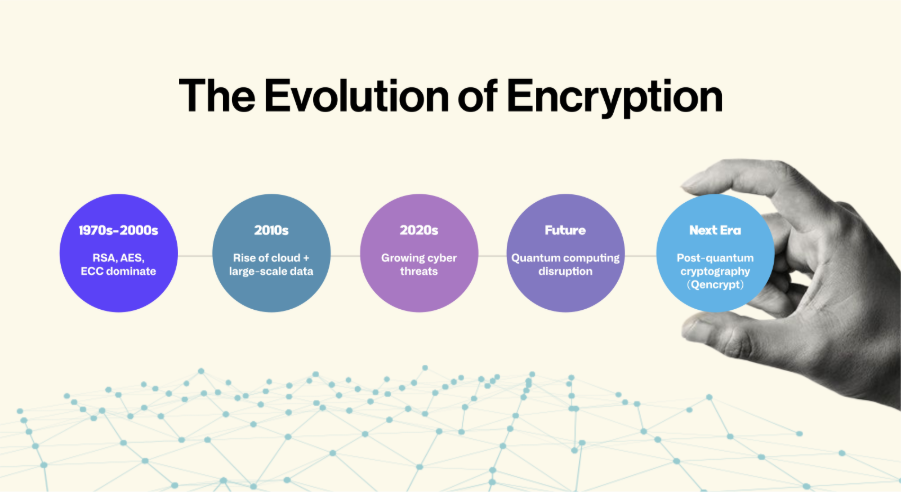
However, as computing power increases, the assumptions underlying these algorithms are being challenged. This has led to the development of new cryptographic techniques designed for the future.
Key innovations include:
- Quantum-resistant algorithms that withstand advanced computational attacks.
- NIST-standardized frameworks guiding the future of encryption.
- Lattice-based cryptography, offering strong security with scalable performance.
- Quantum Key Distribution (QKD) for ultra-secure key exchange mechanisms.
These advancements mark a shift toward encryption systems that are not only secure today but also resilient against tomorrow’s technologies.
How Quantum Computing Changes the Encryption Landscape
Quantum computing represents one of the most significant technological shifts in modern history. By leveraging qubits, quantum computers can process vast amounts of information simultaneously, solving problems that are practically impossible for classical systems.
While this brings enormous potential for innovation, it also introduces serious risks for cybersecurity. Many existing encryption systems rely on mathematical problems that quantum computers could solve efficiently.
The implications are profound:
- Public-key encryption systems like RSA and ECC could become obsolete
- Encrypted data stored today could be decrypted in the future
- Secure communications could be compromised
- Digital authentication systems could be weakened
This has given rise to the concept of “Harvest Now, Decrypt Later”, where attackers collect encrypted data today with the intention of decrypting it once quantum capabilities mature.
Organizations must act now to mitigate these risks and ensure long-term data protection.
Why QEncrypt Delivers Next-Generation Application Encryption
QEncrypt is purpose-built to address the challenges of modern and future cybersecurity. Unlike traditional encryption solutions, it is designed with a forward-looking architecture that prioritizes long-term resilience.
At its core, QEncrypt integrates post-quantum cryptography with practical implementation strategies, enabling organizations to adopt advanced security without complexity.
Key differentiators include:
- A strong foundation in quantum-safe cryptographic principles
- Use of advanced algorithms resistant to emerging attack methods
- Alignment with global standards and evolving security frameworks
- Scalable architecture suitable for modern applications
By combining innovation with usability, QEncrypt ensures that organizations can secure their applications without sacrificing performance or flexibility.
Key Features of QEncrypt for Application Security
QEncrypt offers a comprehensive set of features designed to protect application data at every stage of its lifecycle.
- Quantum-Safe Encryption: Implements fool-proof encryption techniques designed to remain secure against future quantum threats.
- Post-Quantum Cryptography Support: Ensures compatibility with next-generation cryptographic standards and frameworks.
- Secure Local Encryption: Encrypts data directly on the user’s device, minimizing exposure and reducing risk.
- Long-Term Data Protection: Protects stored data from future decryption attempts, ensuring lasting confidentiality.
- Advanced Mathematical Security: Utilizes robust cryptographic models, including lattice-based approaches, to strengthen security.
- Future-Ready Architecture: Designed to evolve alongside emerging standards, ensuring continued relevance and protection.
Industries That Rely on Application Encryption
Application encryption is critical across industries where data sensitivity and regulatory requirements are high.
- Financial Services rely on encryption to secure transactions, prevent fraud, and protect customer data.
- Healthcare Organizations must safeguard patient records and comply with strict privacy regulations.
- Government and Defence sectors require long-term protection for classified and sensitive information.
- Technology Companies depend on encryption to protect intellectual property, source code, and innovation pipelines.
- Legal and Compliance Teams need secure systems to maintain confidentiality of legal documents and communications.
QEncrypt provides a flexible solution that adapts to the unique security requirements of each industry.
The Future of Application Encryption
The shift toward quantum-resistant encryption is already in motion. Governments, enterprises, and research institutions are investing heavily in next-generation cybersecurity solutions.
Key developments shaping the future include:
- Standardization of post-quantum cryptographic algorithms
- Increased adoption of quantum-safe encryption frameworks
- Advancements in secure communication technologies
- Greater emphasis on long-term data protection strategies
Organizations that begin this transition early will be better positioned to handle future threats and maintain trust in an increasingly digital worlds of and so keep safe, details that are important to all of these types of business.
Final Thoughts
The future of cybersecurity depends on how well organizations prepare today. As digital systems grow more complex and cyber threats become more advanced, the limitations of traditional encryption are becoming increasingly clear. The rise of quantum computing adds urgency to this challenge, introducing risks that cannot be addressed with legacy approaches alone.
Application encryption must evolve to meet these demands, shifting from short-term protection to long-term resilience. This is where QEncrypt delivers real value. By combining post-quantum cryptography, quantum-resistant algorithms, and a future-ready architecture, it provides a comprehensive solution for securing modern application data.
For businesses, developers, and enterprises handling sensitive information, adopting quantum-safe encryption is no longer a forward-thinking option; it is a necessity. QEncrypt offers a reliable, scalable, and future-proof path to protecting data in the next era of cybersecurity.