
Quantum computing is no longer a distant concept; it is rapidly becoming a transformative force that could redefine digital security as we know it. Today’s encryption systems, which protect everything from financial transactions to private communications, rely on mathematical problems that classical computers cannot efficiently solve. However, quantum computers introduce a new level of computational power capable of breaking these systems with alarming speed.
What makes this threat urgent? It’s not just quantum computing capability, but present risk. Cybercriminals are already collecting encrypted data with plans to decrypt it later when quantum machines mature.
With over 80% of global internet traffic relying on vulnerable encryption standards, the shift toward quantum-resistant security is no longer optional, it is critical.
Why Quantum Computing Poses a Serious Cybersecurity Threat
Quantum computers fundamentally differ from classical systems, enabling them to solve problems that were previously considered infeasible.
Key risks include:
- Breaking RSA and ECC Encryption: Quantum algorithms like Shor’s algorithm can factor large numbers exponentially faster
- Compromising Secure Communications: Protocols such as SSL/TLS could become obsolete
- Long-term Data Exposure: Sensitive data stored today may be decrypted in the future
- Mass-scale Disruption: Banking, healthcare, defence, and cloud systems are all at risk
This creates a dangerous reality where encryption is no longer a permanent safeguard but a temporary barrier.
How Post-Quantum Cryptography Is Redefining Digital Protection
Post-Quantum Cryptography (PQC) is developed to resist cyberattacks from both classical and quantum computers while ensuring they remain compatible with existing infrastructure.
Its significance is reflected through efforts led by the National Institute of Standards and Technology (NIST), which has been evaluating quantum-safe algorithms since 2016. In 2022, NIST announced its first selected algorithm, marking a significant step toward global adoption. Due to this reason, it’s projected that most organizations will begin transitioning to quantum-safe systems before 2030.
Core characteristics of PQC include:
- Resistance to quantum-based attacks
- Practical deployment on current systems
- Scalability for enterprise and global use
Strong mathematical foundations beyond factorization problems
Why Lattice-Based Cryptography Is Leading the Quantum-Resistant Revolution
Lattice-based cryptography has surfaced as the most promising solution due to its balance of security and efficiency. This algorithm is developed on complex geometric structures that create problems near-impossible to solve, even for quantum computers.
Moreover, it also has a unique mechanism, Learning With Errors (LWE), which adds small noise to equations, making reverse-engineering extremely difficult.
Key advantages include:
- High Quantum Resistance: No known efficient quantum attack exists
- Scalability: Security strengthens as systems grow
- Versatility: Suitable for encryption, signatures, and key exchange
- Real-world Readiness: Already being tested in cloud and secure communications
This makes lattice-based systems a strong candidate for long-term cryptographic standards.
Exploring Quantum Key Distribution as a Physics-Based Security Model
Quantum Key Distribution (QKD) takes a completely different approach by using the laws of quantum mechanics rather than mathematical complexity.
Its security is based on fundamental principles:
- No-cloning Theorem: Quantum data cannot be duplicated
- Measurement Disturbance: Any interception attempt alters the data
- Quantum Entanglement: Tampering is instantly detectable
Key benefits of QKD:
- Detects eavesdropping in real time
- Provides theoretically unbreakable key exchange
- Ensures high levels of data integrity
However, it also comes with limitations:
- Requires specialized hardware
- Expensive to deploy at scale
- Limited infrastructure availability
Despite these challenges, governments and financial institutions are actively investing in QKD for high-security applications.
The Growing Risk of “Harvest Now, Decrypt Later” Attacks
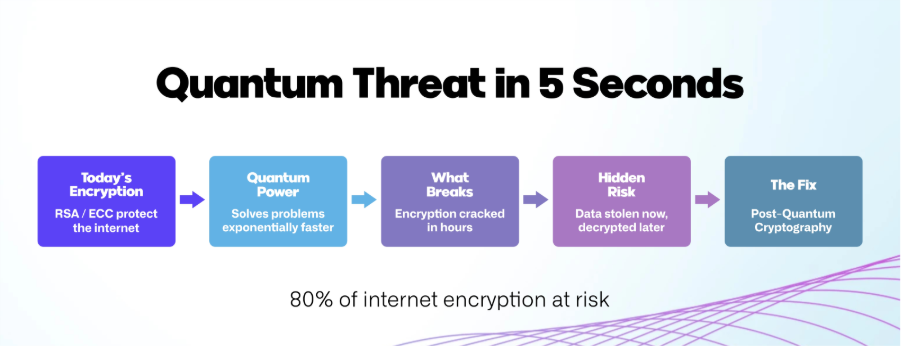
One of the most critical and often overlooked threats is delayed decryption. Attackers are already collecting encrypted data today and storing it for future quantum decryption, particularly targeting long-term sensitive information.
Data at highest risk includes:
- Financial records
- Government intelligence
- Intellectual property
- Healthcare data
Experts estimate that any data needing protection for 10–20 years is already vulnerable, making early adoption of quantum-safe encryption essential.
Key Challenges Organizations Face When Transitioning to Quantum-Resistant Security
Despite the urgency, implementing PQC is not straightforward. Major challenges include:
- Infrastructure limitations: Existing systems are not PQC-ready.
- Performance impact: Larger keys may increase latency and bandwidth usage.
- Integration complexity: Requires system-wide cryptographic upgrades.
- Awareness gap: Many organizations underestimate the timeline of quantum threats.
The Role of Governments and Global Policies in Accelerating Quantum-Safe Adoption
The shift towards post-quantum cryptography is not just a technological transition; it’s a matter of global security. Governments around the globe are increasingly acknowledging the threat posed by quantum computing while taking proactive measures to prepare their digital infrastructures.
Many countries have already begun adopting quantum-safe strategies into their cybersecurity frameworks, focusing on protecting critical sectors including telecommunications, energy, defence, and banking.
Key government-driven efforts include:
- National quantum strategies: Countries are investing billions into quantum research and security preparedness.
- Regulatory guidance: Agencies are issuing timelines and recommendations for transitioning to quantum-safe encryption.
- Public-private collaboration: Governments are working closely with technology companies to accelerate adoption.
- Standardization support: Encouraging compliance with emerging global standards like those developed by NIST.
This coordinated approach is essential because cybersecurity is a shared responsibility. Without global alignment, inconsistencies in encryption standards could create vulnerabilities across interconnected systems. As a result, policy-driven momentum is playing a crucial role in ensuring a secure and unified transition to a quantum-resilient world.
Why Hybrid Cryptography Is Emerging as the Most Practical Transition Strategy
To ease the transition, organizations are adopting hybrid encryption models that combine classical and quantum-resistant algorithms. Benefits of this approach:
- Maintains compatibility with current systems
- Provides immediate protection against future threats
- Allows gradual migration without disruption
- Supports flexibility as standards evolve
Hybrid models are expected to become the industry standard during the transition phase, offering a balanced path toward full quantum security.
Building a Future-Ready Strategy for Quantum-Resilient Cybersecurity
Organizations must take a proactive and structured approach to prepare for the quantum era.
Key steps include:
- Conducting a cryptographic inventory: Identify where encryption is used
- Assessing risk exposure: Focus on long-term sensitive data
- Implementing crypto-agility: Enable rapid algorithm upgrades
- Testing PQC solutions: Pilot implementations before full deployment
- Training teams: Build awareness of quantum risks and solutions
The urgency is reflected in market trends, with the post-quantum cryptography market expected to exceed $10 billion by 2030, driven by demand across finance, defence, and cloud sectors.
Industry Use Cases: How Quantum-Resistant Security Is Transforming Key Sectors
The impact of post-quantum cryptography extends across multiple industries, each facing unique risks and opportunities in the quantum era.
- In the financial sector, where secure transactions are the backbone of operations, quantum threats could undermine trust in digital banking systems. Banks and fintech companies are already exploring quantum-safe encryption to protect payment systems, trading platforms, and customer data.
- In healthcare, the need for long-term data confidentiality is especially critical. Medical records often need to remain secure for decades, making them prime targets for “harvest now, decrypt later” attacks. Quantum-resistant encryption ensures that sensitive patient information remains protected well into the future.
- The defence and government sectors are also prioritizing quantum security due to the highly sensitive nature of their communications. Even a minor breach could compromise national security, making early adoption of PQC essential.
Meanwhile, cloud service providers and tech companies are integrating quantum-safe solutions to secure vast amounts of user data. As cloud adoption continues to grow, ensuring long-term data protection becomes a competitive necessity.
Across these industries, a common pattern is emerging:
- Early adopters gain a trust advantage
- Organizations improve long-term data resilience
- Businesses reduce the risk of future compliance and security costs
As quantum computing continues to evolve, industry-wide adoption of quantum-resistant security will not just be a defensive move, it will become a defining factor in innovation, trust, and market leadership.
QEncrypt: Leading the Transition Toward a Quantum-Secure Future
The shift to quantum-resistant encryption is no longer a theoretical exercise, it is a strategic necessity. As quantum computing continues to advance, organizations that act early will be better positioned to protect their data, maintain trust, and stay competitive.
Post-quantum cryptography, lattice-based algorithms, quantum key distribution, and hybrid models collectively form the foundation of next-generation cybersecurity. The tools are ready; the challenge lies in timely adoption.
In this rapidly evolving landscape, QEncrypt is positioning itself as a market leader in quantum-resistant cybersecurity, delivering advanced encryption solutions tailored for the quantum era.
By combining innovation with practical deployment, QEncrypt is helping organizations move beyond reactive security and build a future that is resilient, adaptive, and truly secure.