
Things are at a critical point in cybersecurity because we need to protect data in areas like banking, medical care, defense, and the storage of information on the “cloud.”
Today, over 80% of global internet traffic relies on traditional encryption methods like RSA and AES, according to industry cybersecurity estimates. These have been reliable for many years. However, quantum computing is developing and is upsetting what we’ve always thought of as being safe in the digital world.
What’s more daunting is that studies indicate that a quantum computer with enough ability could crack RSA-2048 encryption, which is used for many things, in a matter of minutes or hours. Because of this, companies are looking at quantum encryption methods that will be safe with quantum computers and quantum cryptography as ways to be prepared for the future.
What Is Traditional Encryption?
Modern cybersecurity approaches are backed by standard encryption, which transforms information into a secret code with complicated math problems. You need a secret “key” to get the original information back, and without it, the code is incredibly difficult to crack.
RSA, ECC, and AES are the encryption systems we use most. RSA is based on breaking down huge prime numbers, ECC uses the math of elliptic curves, and AES uses a matching key on both ends of the communication.
We consider these to be safe because even the quickest supercomputers would take far too long to solve them.
In fact, today’s regular computers would take longer than the entire existence of the universe to figure out a 2048-bit RSA key. That’s a big reason why standard encryption is still the method of choice for things like online banking, secure messaging, and government communications.
However, these encryption methods rely on the assumption that attackers are using standard computers. As quantum computing improves and many big tech companies are doing a lot of research into it, this idea is becoming less certain.
What Is Quantum Encryption?
Instead of complicated math, quantum encryption (or quantum cryptography) relies on the rules of how things work at the quantum physics level to keep communications safe. Quantum Key Distribution (QKD) is a frequently talked about method where encryption keys are sent using quantum particles, as in photons of light.
Quantum encryption’s strongest point is how it knows if someone’s listening. If someone attempts to look at or check a quantum signal, the signal itself is immediately altered, and both the person sending and the person receiving are notified. This is because of the quantum principle that you can’t observe a quantum state without changing it.
What this principle boils down to is that any attempt to secretly listen in on a quantum channel will obviously show that it’s been done. This is totally unlike normal encryption; if someone is careful, they can intercept and read data with standard encryption, and you’d never know.
Research into sending information using quantum methods shows that QKD systems have been tried and tested over 400 kilometers of fiber optic cable and even further with experiments using satellites, proving it is possible to have truly safe communications in the real world.
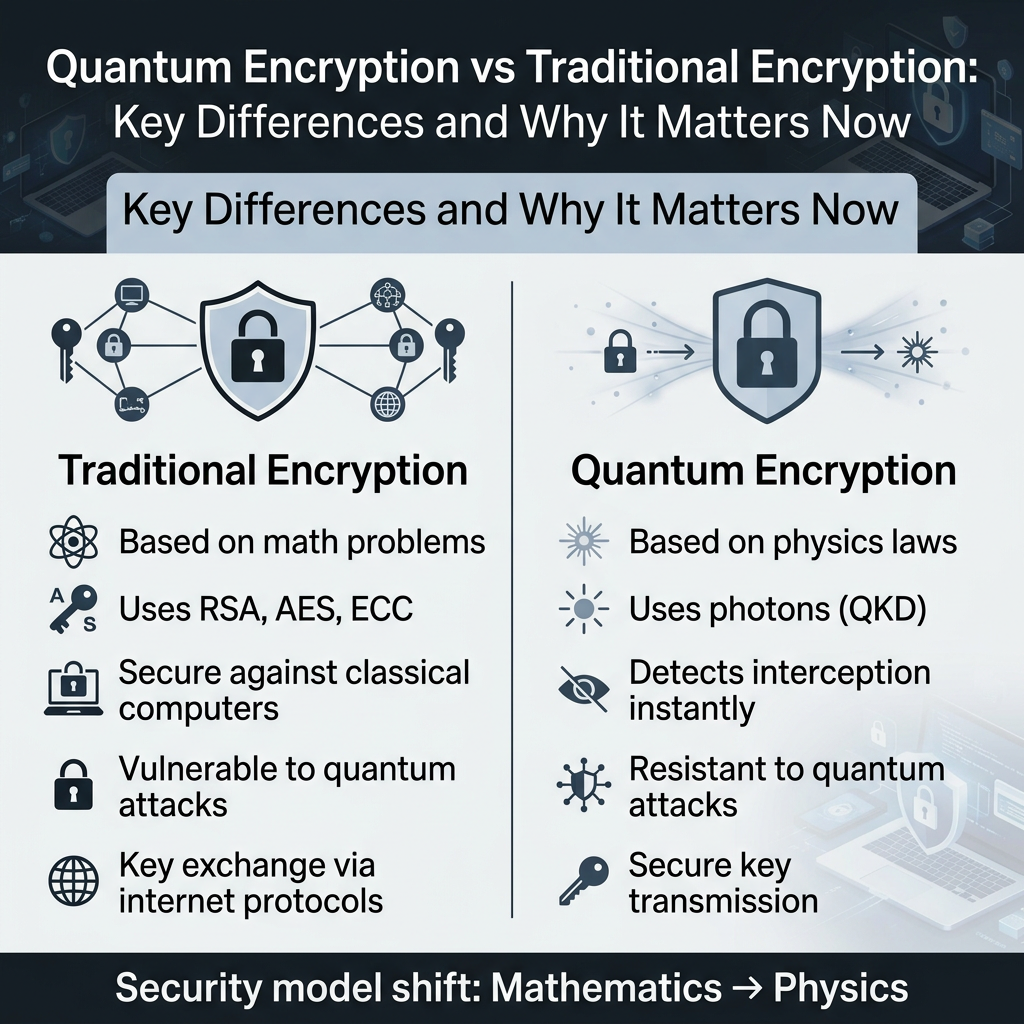
Traditional vs Quantum Encryption: Key Differences
1. Underlying Principle
Regular encryption works because of complicated math. It stays safe as long as certain calculations are too hard for anyone to do. RSA and ECC are examples of this, and they use issues that are simple in one direction but unbelievably hard to undo.
Quantum encryption is different; it’s based on how things work in the world of physics. It doesn’t assume someone can’t figure out the answer, but that if anyone tries to look at a quantum system, it will change. This means its security comes from physics, not math, and it’s a completely different approach from how we normally do things with encryption.
2. Security Model
Regular encryption works because breaking the code would take an attacker an impossibly long time with today’s computers. But computer power is getting better, and especially with the development of quantum computing, that might not be true for much longer.
Quantum encryption is a different idea for keeping things secure. It doesn’t aim to make attacking the system too difficult. Rather, it is designed to show you if someone is attacking it right away. This means cybersecurity goes from just stopping attacks to stopping them and being able to see any meddling on the actual hardware itself.
3. Key Distribution
Currently, computers share secret keys for encryption with security systems like TLS or PKI. However, these methods that work well now may not be safe in the future if quantum computers succeed in breaking the mathematical problems (such as RSA) they rely on.
Quantum encryption, on the other hand, uses Quantum Key Distribution (QKD) to send keys by way of quantum physics. The quantum ‘form’ of the key changes when someone looks at it, so anyone attempting to secretly listen in is instantly detected. This means, in theory, exchanging keys this way is a lot harder to secretly get to and read.
4. Threat Resistance
Good old, standard encryption is forceful against attacks from regular computers. But quantum algorithms, and particularly Shor’s algorithm, can quickly find the factors of very large numbers. Because of these developments, commonly used encryption methods like RSA and ECC will at some point likely be cracked.
Quantum encryption avoids these computing attacks because it doesn’t rely on tricky math problems. Its security comes from the laws of physics, so it’s safe from both normal and quantum computer attacks. Unfortunately, it’s not being used everywhere yet because of practical difficulties in making it work in the real world.
Why Quantum Computing Changes Everything
The way we tackle cybersecurity attacks today is about to change completely with quantum computing. Traditional computers use bits 0 or 1, a single choice. Quantum computers, though, use qubits, and these can be a 0, a 1, or both at the same time.
Because of this, quantum computers can be vastly, incredibly faster at calculations. For keeping things secure (cybersecurity), this means that today’s computers could break codes that would take thousands of years to crack.
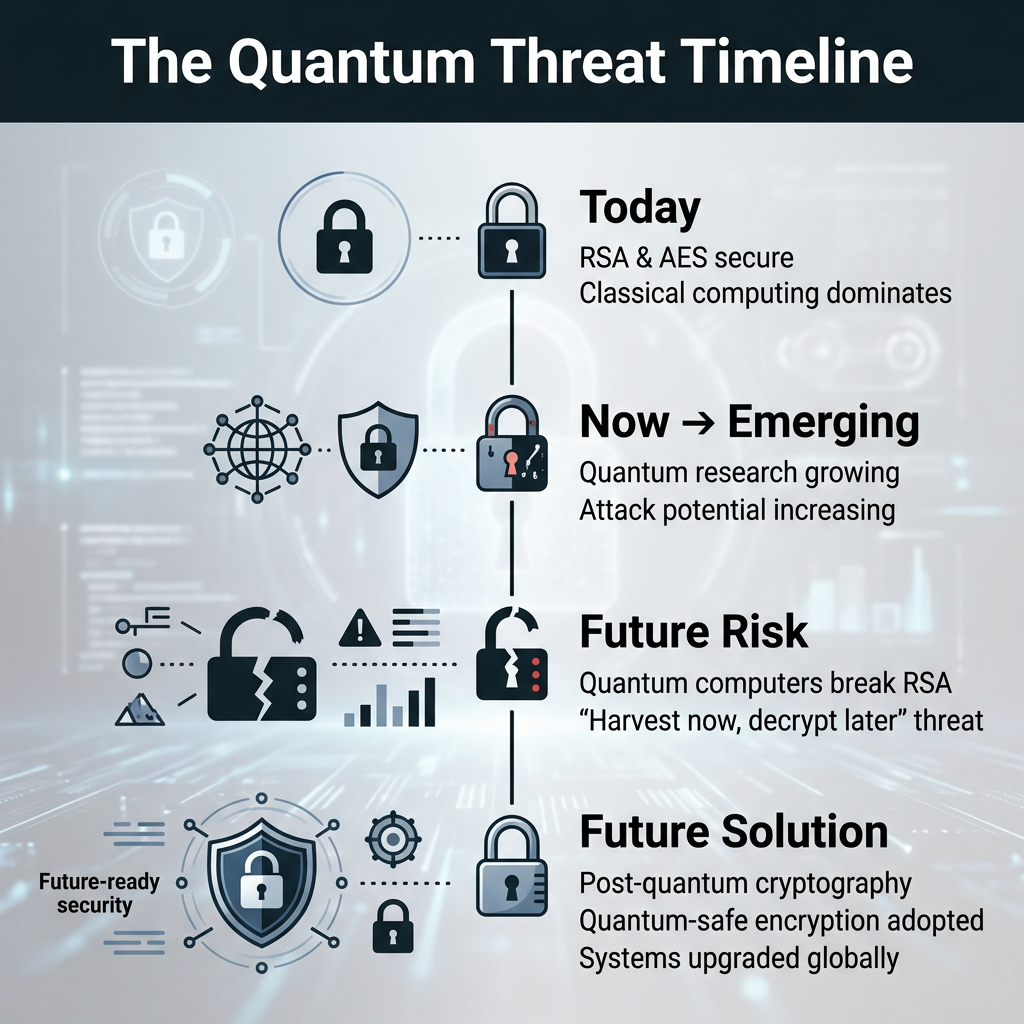
One big worry is the “harvest now, decrypt later” idea. Attackers are hoarding encrypted information now, planning to unlock it as soon as quantum computers are strong enough to do so. This is particularly worrying for data we need to keep private for a long time: government secrets, your medical details, and details of financial transactions.
Most people who know about this stuff are convinced quantum computing isn’t something for the far future. IBM and many others have built quantum processors with more than 100 qubits, and the whole area is getting much more advanced every single year.
Quantum Safe Encryption and Quantum Proof Encryption
Quantum encryption isn’t quite here in its final form yet, so cybersecurity experts are busily developing encryption standards that are quantum-proof. Importantly, these methods aren’t using quantum physics themselves. Rather, they’re built on new kinds of mathematical algorithms, which are thought to withstand breaking from both the computers we have now, and the quantum computers of the future.
And this is where Post-Quantum Cryptography, or PQC, is so critical. The goal of PQC is to swap out currently weak systems such as RSA before quantum computers get strong enough to crack them.
In fact, a really important step in improving cybersecurity worldwide, the U.S. National Institute of Standards and Technology (NIST) chose several PQC ‘recipes’ in 2022 to become the official standard.
Post-Quantum Cryptography: The Real-World Solution
Post-quantum cryptography provides practical encryption methods that can run on existing systems while resisting quantum attacks. These algorithms are being actively standardized and tested worldwide.
- CRYSTALS-Kyber (Key Encapsulation)
Kyber is designed for secure key exchange. It is efficient, fast, and considered one of the leading candidates for future encryption standards. Its structure makes it resistant to known quantum attack models.
- Classic McEliece (Key Encapsulation)
This is one of the oldest cryptographic systems still considered secure. While it requires larger key sizes, it has withstood decades of cryptanalysis and remains highly trusted.
- CRYSTALS-Dilithium (Digital Signatures)
Dilithium is used for verifying digital identities and ensuring data integrity. It is efficient and has been selected as part of NIST’s post-quantum standards.
- Falcon (Digital Signatures)
Falcon focuses on smaller signature sizes and fast verification, making it useful for performance-sensitive applications like mobile systems.
- SPHINCS+ (Digital Signatures)
SPHINCS+ is based on hash functions and provides strong security guarantees without relying on algebraic structures, making it highly robust against quantum threats.
These algorithms represent the foundation of quantum-safe digital infrastructure.
Final Thoughts
Cybersecurity is changing dramatically as we go from older encryption methods to security based on quantum physics. For many years, systems like RSA, ECC, and AES have been the main way we’ve protected information, but the development of quantum computing presents dangers we can’t dismiss. Studies indicate that quantum computing methods could crack common encryption much quicker than anyone thought, and that means we need much better protection.
That’s where quantum encryption or quantum cryptography holds great importance. At the same time, encryption that is ‘quantum proof’ and post-quantum algorithms like CRYSTALS-Kyber, Dilithium, Falcon, SPHINCS+, and Classic McEliece are giving us ways to use more secure systems in the world as it is.
Businesses and other organizations should start preparing for a future where quantum computers are available now, not when they are forced to. QEncrypt, for example, is helping with this change by providing security solutions that will work with quantum computers.
Explore more at https://qencrypt.app/