
Encryption keeps nearly all of what you do with computers safe. It’s a sort of secret code, operating in the background to keep your private stuff private as it goes across the internet.
As technology becomes more sophisticated, quantum computing is introducing an impressive way of doing calculations that is making us rethink everything we thought we knew about security.
Quantum computing, which not long ago was just something scientists dreamed about, is getting closer to being usable. This development has the cybersecurity world distressed about whether the encryption we use now will continue to be secure.
So, the situation isn’t just a ‘what if’ anymore. Experts are now asking how long it will be before we need to replace encryption, and crucially, what we can do now to get ready for a future after quantum computers are here, a future in which protecting information will have to be done by a completely different set of rules.
Understanding Quantum Computing
The way quantum computing works is completely unlike how regular computers do. Normal computers have bits that are either a 0 or a 1. Quantum computers use qubits, and because of something called “superposition,” a qubit can be both at once. Entanglement allows qubits to connect and perform complex calculations simultaneously.
Quantum computers aren’t just going to be zippier versions of the computers we have now. They’re going to tackle certain kinds of problems in totally different ways.
But when we think about keeping things secret (cryptography), that computational power also makes things a little scary. The complicated math problems that currently protect encrypted information might not be safe anymore if quantum computers become big and reliable enough.
Why Encryption Could Be at Risk
Modern encryption is built on mathematical problems that are intentionally difficult for classical computers. These include:
- Large Number Factorization
RSA encryption relies on the challenge of breaking large numbers into prime factors. This is extremely time-consuming for classical systems.
- Discrete Logarithm Problems
Elliptic Curve Cryptography (ECC) depends on mathematical structures that are difficult to reverse without a secret key.
- Secure Key Exchange Systems
Protocols like Diffie-Hellman allow secure communication over insecure networks by relying on mathematical asymmetry.
However, quantum algorithms, including one called Shor’s Algorithm, are supposed to be able to solve these puzzles much, much faster than standard computers. When quantum computing becomes widespread and workable, it could seriously undermine the security of pretty much all of our current public-key encryption.
Are Quantum Computers a Real Threat Today?
Quantum computers are getting better at an amazing speed, but right now researchers are still testing and playing with them. The actual machines we have now are shaky, make a lot of mistakes, and have trouble keeping qubits in that weird in-between state they need to work.
Because of these limitations, they can’t yet crack the encryption that protects most of our stuff online. But research is speeding up.
A few analyses show that to break RSA encryption (a common type), you’d need thousands of qubits that all work reliably with each other, and we’re nowhere near having that yet. However, how quickly we’re building and improving these things is changing the predictions.
Quantum Computing Security Risks
Quantum computing introduces several indirect security concerns beyond direct encryption attacks.
- Long-Term Data Exposure
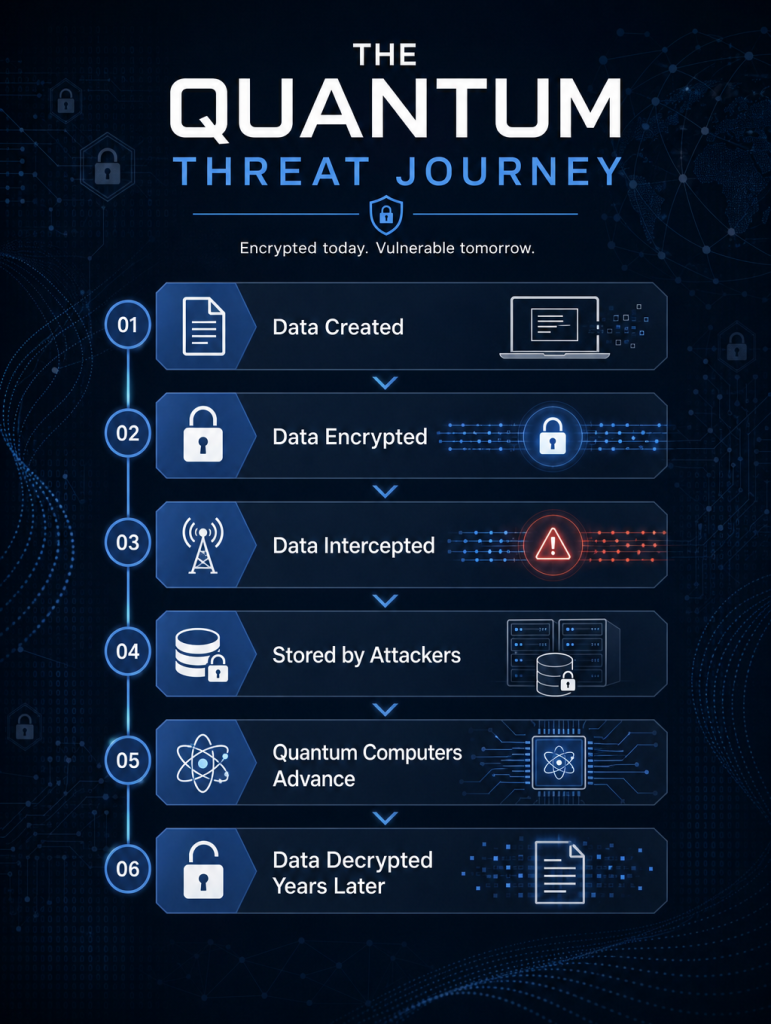
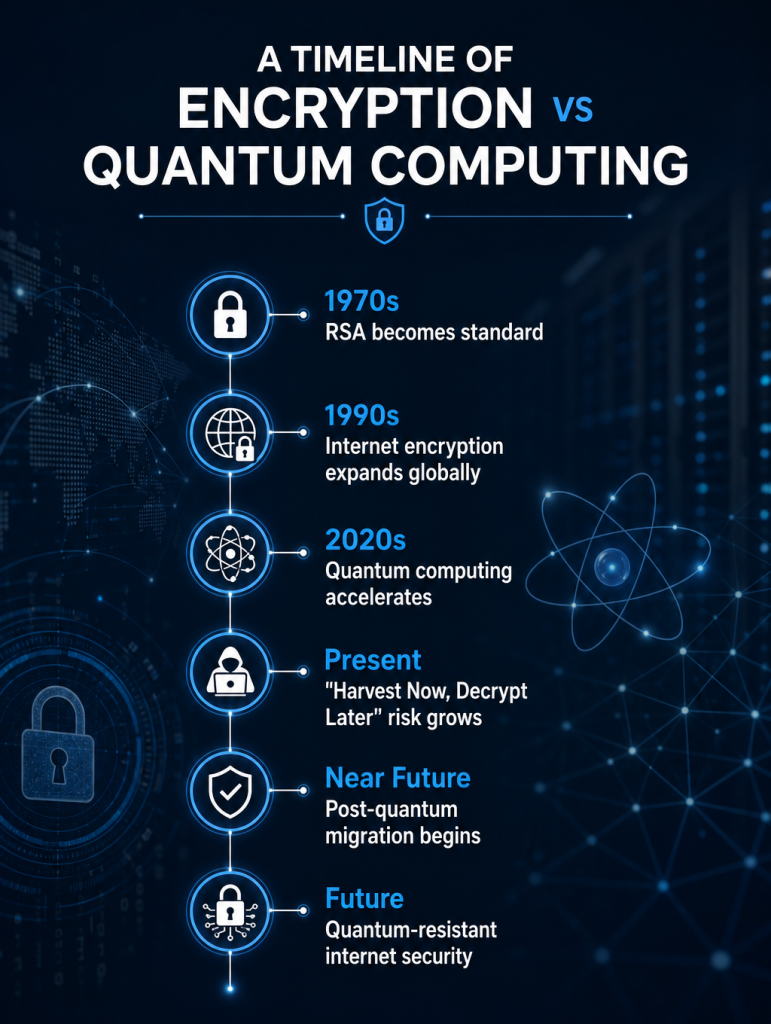
Attackers may store encrypted data today with the intention of decrypting it later when quantum capabilities improve. This creates a delayed but serious risk for sensitive information.
- Critical Infrastructure Vulnerabilities
Energy grids, transportation systems, and healthcare infrastructure rely heavily on encryption for safe operation.
- Financial System Integrity
In a post-quantum environment, cryptographic trust models could challenge banks, payment systems, and financial networks.
- Digital Identity Systems
Authentication mechanisms such as digital certificates and signatures may require redesign to remain secure.
What Is Quantum-Resistant Encryption?
Quantum-resistant encryption, or post-quantum cryptography, is about making encryption methods that will stay safe and sound even if (when, probably) quantum computers become a serious threat.
Right now’s encryption uses some really tricky math problems, but quantum computers are expected to be able to solve those fairly easily. So, these new systems are using totally different kinds of math, math that we think will hold up against attacks from both regular computers and quantum computers.
The goal isn’t to eliminate the risk of encryption being broken, but to ensure our security lasts as computers become more powerful.
QEncrypt: A Real-World Transition to Post-Quantum Security
As quantum computers become common, a huge hurdle for businesses is not knowing that quantum computing is a risk; it is setting up defenses that will actually work and can grow, all without breaking what they already have.
QEncrypt is about a sensible, step-by-step shift to security, not just fancy quantum-related theories.
The Problem: Legacy Encryption in a Changing World
Here’s the issue: the encryption most companies use right now is decades old and, in fact, wasn’t designed to deal with the power of quantum computers. A complete overhaul?
Unfortunately, it’s not happening soon. Systems are too interwoven; stopping everything to change over will be seriously expensive, things need to still work with computers all over the world, and security improvements can’t cause everyday business to grind to a halt.
Because of all this, companies are facing a period of change, a move from one thing to another, rather than a simple improvement to their current systems.
The QEncrypt Approach
Instead of forcing a complete overhaul, QEncrypt uses a layered transition strategy that lets organizations gradually adopt quantum-resistant encryption while keeping operations running smoothly.
The platform is designed around three core principles:
1. Hybrid Security Integration
QEncrypt enables systems to run traditional encryption alongside quantum resistant methods. This ensures that organizations remain protected while gradually migrating toward next-generation standards.
2. Cryptographic Flexibility
Rather than locking organizations into a single approach, QEncrypt is built to support multiple cryptographic pathways. This flexibility allows security teams to adapt as standards evolve.
3. Future-Ready Architecture
The system is designed to support evolving cryptographic standards, meaning organizations do not need to rebuild their security infrastructure every time new protocols are introduced.
Real-World Application Scenario
Think about a bank or any big company that handles millions of payments and things every day. You can’t just swap out all their ways of encrypting information for something new all at once, or the whole system would break down. But with a plan like QEncrypt, the current systems continue to work as usual.
At the same time, we are slowly adding encryption that quantum computers can’t break. Then, we slowly move the important details over to the much more secure protections.
And security specialists will monitor things closely, adjusting as the best security methods develop. This makes a huge difference by keeping things running smoothly and preparing for a more secure future.
Why This Matters
QEncrypt isn’t valuable just because it’s hard to break the encryption. It’s about actually being able to move to quantum-resistant security for lots of things at once. Loads of companies know quantum computers pose a threat, but they don’t have anything they could realistically do about it. QEncrypt’s methodical plan for changing things over means security gets better but won’t wreck your current setup, your programs, or your way of doing business.
Common Misconceptions
The idea that quantum computers will instantly ruin everything isn’t quite right. Building big, powerful quantum systems that could crack codes is happening, but we’re still a good number of years away from having them and being able to actually use them.
- It’s not only governments who should be concerned. Any group, businesses and cloud storage companies included, that has private information or data they need to keep safe for a long time could eventually find that information vulnerable.
- Encryption isn’t going to vanish. It will get upgraded, turning into more resilient ‘post-quantum’ encryption systems specifically created to withstand the ways these new computers will attack things.
- Though quantum computing is moving forward quickly, the quantum computers we have now are experimental and, crucially, aren’t steady enough to break the encryption that protects things in the actual world.
- You can’t safely put off moving to post-quantum encryption. Waiting to adopt it makes things riskier in the long haul, and is especially worrying for data that has to be confidential for many years.
Quantum Cryptography vs Post-Quantum Cryptography
Quantum cryptography relies on the bizarre rules of quantum physics to create really safe ways to send messages, and it does so a lot of the time by distributing a secret key using quantum methods. It’s incredibly secure in principle, but making it work all over the world with our current internet is a huge challenge.
Post-quantum cryptography, on the other hand, involves complicated calculations that your current computers can perform yet will still hold up against attacks from a quantum computer. And for this reason, it’s something we can actually use now; it’s what most of the world is working on as they update their computer security.
Final Thoughts
Will quantum computers break encryption? Quantum computers could eventually make much of the public-key encryption we all rely on essentially useless, but don’t worry about it happening right now.
Quantum computing is still developing and not yet able to crack today’s encryption on any significant level. But, and this is important, it is steadily improving, and those who study security, both researchers and cybersecurity groups around the world, are really thinking about the dangers down the line.
In fact, instead of just waiting for the inevitable, businesses and other organizations are busily creating new ‘post-quantum’ encryption rules to be ready. Because we weave encryption into everything we do online, this shift will be a slow process. Really the most important thing to do is get ready, not to get upset. Companies that start to plan for security against quantum computers now will do much better when those future problems arrive.
Encryption is changing, is already being updated, and being ahead of the curve, responding to it all, will be how we build safety and faith in the next stage of the digital world.
Be prepared. Don’t let your valuable data harvest now; decrypt later!