
These days, pretty much all businesses heavily invest in cybersecurity solutions to protect their information. They install firewalls to regularly check that their backup plans work and to encrypt their data. But under all that, a big danger is building, which the current ways of encryption are not equipped to handle.
As companies continue to use classical encryption methods, they’re more exposed to more cyberattacks that will happen because technology is changing so quickly. And, even more to the point, quantum computing is starting to drastically change the world of cybersecurity, and lots of organizations aren’t ready for this.
Right now, traditional encryption methods might appear strong, but they weren’t created to cope with the amount of processing ability we’ll have in the future. So, figuring out the secret risks in data we think of as safe isn’t something we can choose to do; it’s a must.
And that’s why quantum-resistant cryptography isn’t just something to be aware of; it’s completely necessary if we’re going to protect data for the long haul.
The Illusion of Data Security
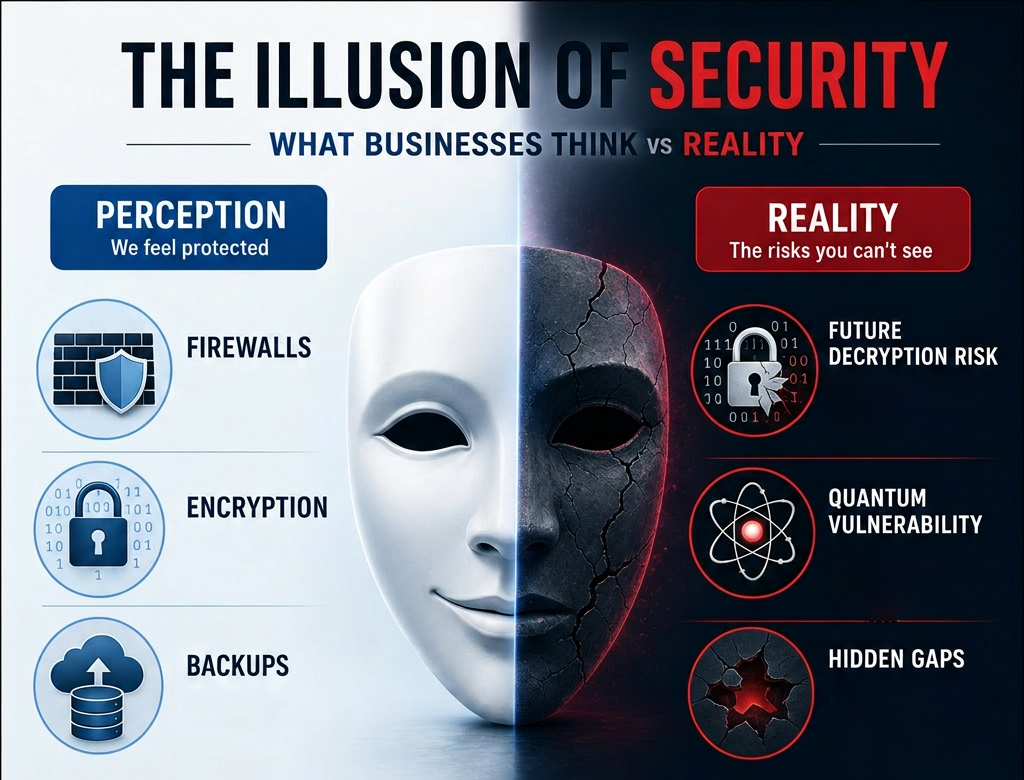
Most businesses, looking at how things are usually done, feel their data is protected. They’ve got encryption, who’s allowed to see what, and they’re making copies of everything. That makes them feel secure. Sadly, that feeling of safety is often based on ideas that aren’t current.
Standard encryption, like RSA and ECC, are developed based on complex mathematical problems that normal computers would struggle with for ages. But these weren’t intended to hold up against the power of quantum computing, and because of that, things we think of as safe now could be unlocked easily in the near future.
What’s more, a lot of organizations don’t realise that keeping data safe isn’t simply about stopping someone getting in right now. It’s about making absolutely sure confidential details are protected for years, for many years, even for decades down the line.
Harvest Now, Decrypt Later (HNDL): A Silent Threat
Some cyberattacks don’t happen all at once; in fact, many are built slowly, over years. And one of the most worrying of these involves quietly gathering all your protected information now, with the goal of being able to unlock it later, when quantum computers are powerful enough. This long, slow plan of action could completely destroy the security of how we protect information in the modern world.
Industries where keeping confidential data for many years is essential, like medical records and financial details, are in a particularly tight spot. The encryption keeping your information safe at present might not be strong enough to survive the incredible processing abilities of computers in the future.
Basically, by not using encryption that will be safe against quantum computers, companies are creating a sealed container of private details, just waiting for someone to open it. It’s far more sensible to begin getting ready now, before the future gets here.
Hidden Vulnerabilities in Existing Systems
Encryption is certainly vital for staying safe online, but it’s not the whole story. Many security loopholes exist, yet they often go unnoticed.
1. Legacy Infrastructure
Older computer systems often can’t be updated to use the latest, strongest encryption, and this turns them into the easiest parts of your security to attack.
2. Misconfigured Security Controls
And even if you have really good security programs, they won’t protect you if they aren’t set up correctly. In fact, mistakes in how security is arranged are still a main reason for data being stolen.
3. Third-Party Risks
Companies frequently use suppliers and collaborators, yet these outside groups probably don’t have the same levels of security. Because of these reasons, your business can be at risk from cyber-attacks through them.
4. Backup System Weaknesses
Backups are absolutely needed, of course. However, the usual ways of backing things up can actually be weak points. Unprotected backups or ones kept in a risky place are simple for hackers to get at.
The Growing Impact of Data Sharing
Organizations have security problems from within, but how they get information to each other also creates dangers that aren’t obvious. As companies get bigger, they hold and share huge amounts of information between different systems, companies they work with, and locations.
This flow of data, though, gives attackers more chances to get in. If the data isn’t properly encrypted, or if not many limits are put on who can see it, confidential information could be stolen or improperly used.
What’s more, a lot of businesses don’t realize how rapidly information they’ve shared will get out of their hands. Once information is out in the open, it is extremely difficult to stop it from being distributed further.
AI and Automation: A Double-Edged Sword
AI and automation tools are changing all kinds of business operations, yet they’re creating fresh security problems as well. AI can be brilliant at finding and dealing with dangers, but if it isn’t protected well, it can make those dangers much worse.
Think about the fact that AI systems need huge amounts of information, and this data frequently includes private details. A breach of these collections of information could be really damaging. Moreover, people with malicious intent can employ AI to spot weaknesses in systems with greater speed and begin far more complex attacks.
Because of this, when companies start using solutions powered by AI, they truly must completely reassess how they protect their data.
Why Traditional Encryption Is No Longer Enough
Lots of organizations use standard encryption, but it has a core problem: it wasn’t designed with quantum computers in mind. Quantum computing can tackle very difficult math problems incredibly quickly, way faster than the computers we have now.
Because of this, the encryption we all use so much could suddenly be useless when quantum computing advances to a more mature stage.
Therefore, just continuing to use present encryption isn’t really keeping us safe. Companies need to start changing to encryption that will still work with quantum computers, so their information will continue to be protected for the long haul.
What Is Quantum-Resistant Cryptography?
Quantum-resistant (or quantum-safe) cryptography is simply a way of encrypting things so that neither regular computers, nor the quantum computers of the future, can break the code.
The algorithms it uses aren’t like current encryption: they’re developed based on math problems and algorithms that are hard to crack, even if you have a quantum computer. Because of this, they’re essential if you want your cybersecurity to stay effective as time goes on. And switching to quantum computing cryptography isn’t only for worrying about dangers down the line, it’s about keeping safe the information we’re creating and storing right now.
Steps to Prepare for a Quantum-Safe Future
To address these hidden risks, organizations should take a proactive approach:
1. Conduct a Cryptographic Inventory: Identify where and how encryption is used across the organization.
2. Prioritize Sensitive Data: Focus on protecting data that must remain secure for many years.
3. Evaluate Quantum-Safe Solutions: Explore and test quantum-resistant cryptography options.
4. Strengthen Overall Security Posture: Address existing vulnerabilities, including misconfigurations and third-party risks.
5. Build Awareness and Expertise: Educate teams about emerging threats and the importance of quantum-safe strategies.
The “Obvious” Cost of Inaction
If you don’t deal with these dangers that aren’t obvious, some catastrophic things could happen. Losing data in a breach will not only cost you money, but it will also harm what people think of your company and how much faith customers have in you.
What’s even more significant is that businesses that put off getting cryptography that’s safe for the quantum computing era may be completely without a defence when it is a problem. By that point, the information that’s already been out in the open won’t be secure.
So getting on with it now is a lot cheaper than trying to fix a disaster later.
Final Thoughts
Data is becoming increasingly valuable, and because of this, what we mean by “secure” is shifting quickly. Standard security steps are still necessary, but they aren’t sufficient to defend against new and future dangers. Weaknesses stemming from older systems and the development of newer technologies mean that we need to think much more about protecting data for the future.
That’s where QEncrypt is useful. Because quantum computing is completely altering cybersecurity, this tool allows companies to go further than quick fixes for security and build a strong defence that lasts. Using cryptography that quantum computers can’t break, QEncrypt makes sure confidential data is safe now, and will continue to be safe for a long time to come.