
For ages, encryption has quietly been the thing keeping our online world safe. Both companies and people have depended on encryption as a pretty darn secure way to prevent hackers from accessing confidential information.
But, as tech gets better, the dangers to it get better, too. And now, with quantum computing becoming a reality, security specialists are having to question all their assumptions about how we protect data. Standard encryption? It’s doing a good job for now, but it won’t be safe forever.
That’s when quantum-safe encryption comes in. It’s a completely new type of security, built to handle the unbelievably strong number-crunching abilities of quantum computers. As we all do more of life online, it’s incredibly important to understand how encryption functions, and specifically, where it’s vulnerable.
What Is Encryption and Why Does It Matter
Essentially, encryption is about scrambling information you can read (we call that ‘plaintext’) into a form that looks like complete nonsense (that’s ‘ciphertext’). This means that only the people who are supposed to know what it says, and who have the special ‘key’, can turn it back into the original.
In fact, encryption is busily at work whenever you email something, buy things online, or keep files on internet storage.
There are two primary types:
- Symmetric encryption
- Asymmetric encryption
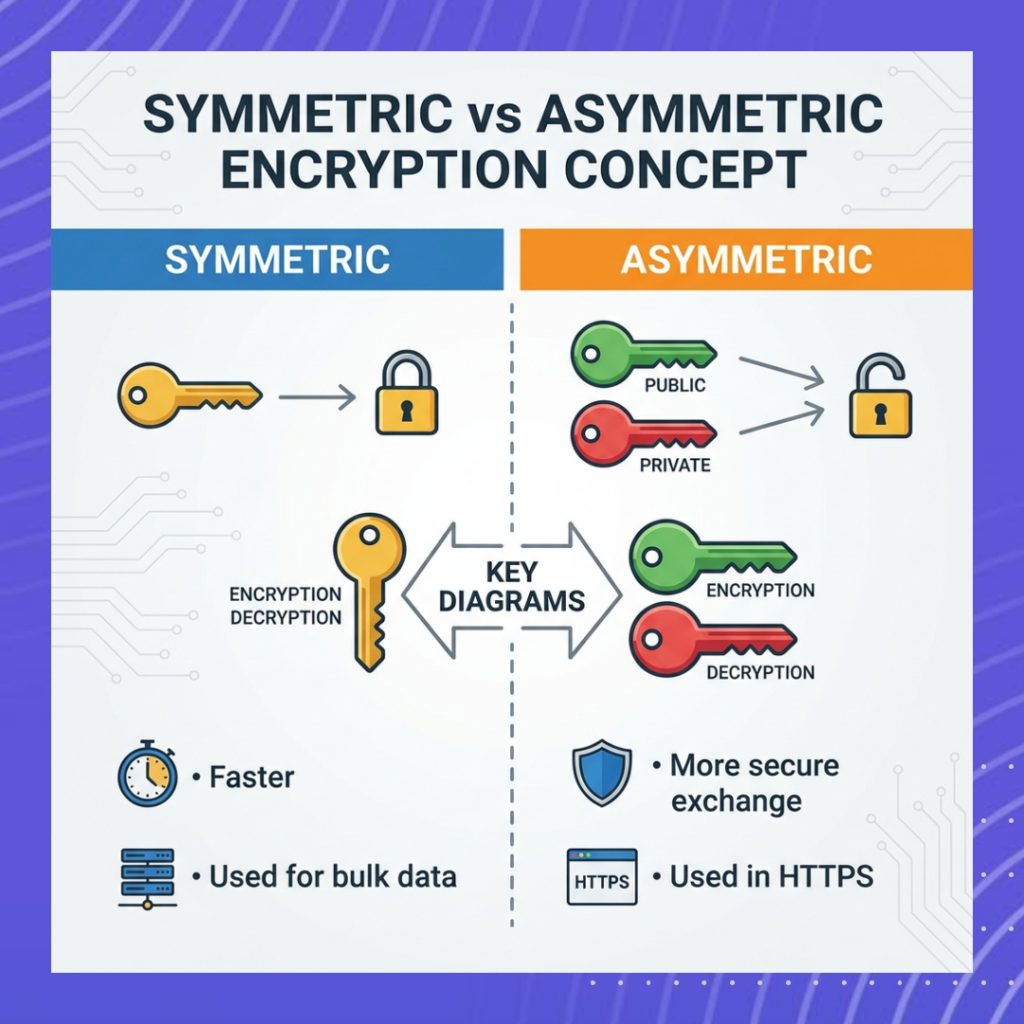
With symmetric encryption, one and the same key locks and unlocks the information, so it’s fast. Asymmetric encryption is different; it employs a pair of keys, a public one for locking and a private, secret one for unlocking. This two-key system is what makes things like secure HTTPS websites possible.
And encryption does so much more than just keeping things private. It guarantees that the information hasn’t been changed by someone else, confirms that it really is from who you think it’s from, and stops people who shouldn’t have access. Without encryption, the whole digital world as we know it would be a very unsafe place to do anything.
The Rise of End-to-End Encryption (E2EE)
These days, pretty much everywhere in the world, for keeping messages and things you do online private, End-to-End Encryption (E2EE) is what’s expected. With E2EE, your message is encrypted on your phone or computer and stays encrypted until it gets to the phone or computer of the person you’re talking to. The company providing the messaging service, therefore, can’t read what you’re sending.
Because of this, E2EE makes it much harder for your info to be stolen while it’s going across the internet; even if someone manages to grab the message, they’d need the special ‘key’ to decrypt it and have no way of reading it. As people worry more about their privacy, a lot more companies are using end-to-end encryption to show customers they’re trustworthy and to follow laws about protecting data.
But, and this is important, as good as E2EE is now, it won’t be safe forever from the dangers of the ‘quantum’ future. That’s because at its heart, end-to-end encryption depends on complicated calculations, and future quantum computers will be able to solve these.
How Encryption Keeps Data Safe Today
Traditional encryption works because of very complicated maths. These calculations are tricky puzzles for classical computers to figure out. Many of the encryption systems we have now, for example, are built around how difficult it is to find the factors of huge numbers, or to solve discrete logarithms.
Because of how much processing power these things need, it would take regular computers thousands, even millions of years to break them. And that’s why encryption has been deemed safe to use for a long time.
Additionally, encryption is used across multiple layers of security:
- Data at rest (stored data)
- Data in transit (moving across networks)
- Data in use (being processed)
Where Traditional Encryption Starts to Break
Classic encryption, for all that it can do, isn’t unbreakable. The main problem with it is that it depends on how hard it is to do calculations. If computers ever get sufficiently powerful, these encryptions could, in theory, be broken in just a few hours.
Quantum computing disrupts all of that. Quantum computers work in an entirely different way from the standard computers we’re used to. Regular computers handle information as bits that are either a 0 or a 1, but quantum computers use quantum bits or qubits, which can be multiple things at the same time.
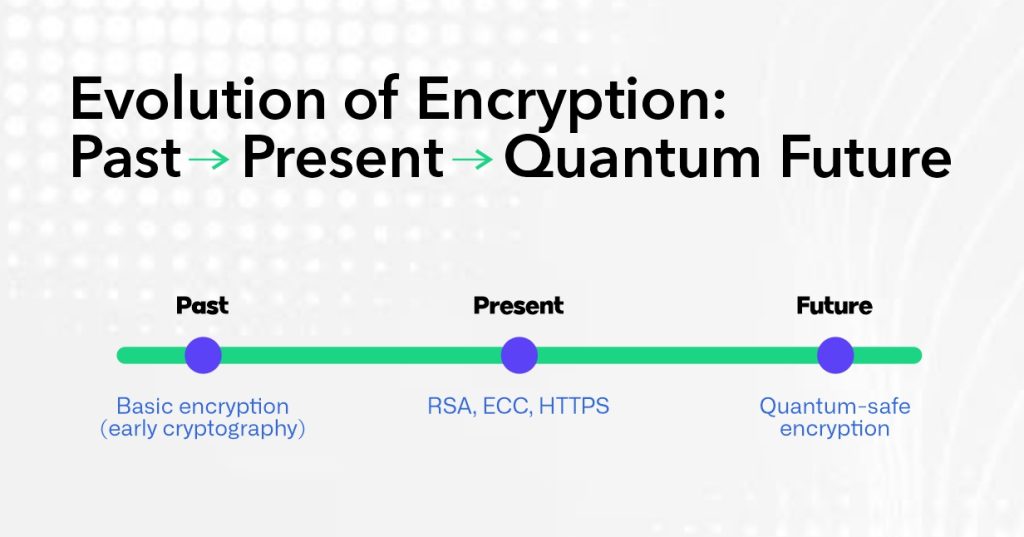
Because of this, quantum computers can solve math problems incredibly, unbelievably quickly. Shor’s algorithm, for example, has the potential to break common encryption systems like RSA and ECC.
So, data that is secured at this moment could be unmasked later, once quantum computers reach a certain level of power.
Enter Quantum Safe Encryption
Because quantum computers will be able to break many of the codes we use now, quantum safe encryption (or quantum safe cryptography) is being created to withstand attacks from these new machines. Regular encryption depends on tricky math that quantum computers would be able to do quickly.
Quantum-resistant encryption instead uses calculations based on algorithms that people think will still be hard even for quantum computers. These include:
- Lattice-Based cryptography
- Hash-Based Cryptography
- Multivariate polynomial cryptography
- Code-based cryptography
These are the key drivers behind the quantum-resistant encryption methods being worked on and made into official standards around the world. Quantum safe encryption is for one thing only: to make certain private details are protected, not just at present, but when quantum computing becomes common.
The Transition to Quantum-Safe Cryptography
Adopting cryptography that can withstand quantum computers isn’t going to be easy. Businesses and other organizations will need to look at how their systems work now, pinpoint where they are weak, and then start using totally new ways of encrypting information.
This transition involves several key steps:
- Inventory of Cryptographic Assets: Organizations must identify where and how encryption is used across their systems.
- Risk Assessment: Determine which data is most sensitive and needs long-term protection.
- Algorithm Replacement: Replace vulnerable algorithms with quantum- resistant encryption methods.
- System Updates: Ensure compatibility with new cryptographic standards.
- Continuous Monitoring: Stay updated with evolving standards and threats.
Importantly, governments and the organisations that set standards are already on the case of deciding what these quantum-resistant methods will be and giving them the official thumbs-up. Being one of the first to update is going to be very important for remaining protected from what’s coming.
Challenges in Adopting Quantum Safe Encryption
It’s obvious why you’d want to use quantum-safe encryption, but making the switch isn’t so simple. Lots of the encryption methods that will withstand a quantum computer attack need a lot more processing power, which could slow things down and make it harder for your systems to grow.
Getting these new methods to work with what you’ve already got is complicated. Companies might have to completely rework sections of their computer setup to use the new encryption.
And nobody’s quite decided yet on which encryption will be the one everyone uses in the end. Because of that, some are nervous about pouring a lot of money into something that might not be the final choice.
However, putting off the change could be a much, much worse idea. If someone gets into your data, particularly private or legally protected information, the damage will be far more expensive than changing your encryption now.
Why Businesses Must Act Now
We don’t know exactly when quantum computers will emerge with their complete capabilities, but the danger they present is very much happening right now. Cyber criminals are hoarding information that’s currently locked with encryption, planning to unlock it later.
This is particularly worrying for businesses because all the data, they’ll want to keep safe for years; things like their important ideas (intellectual property), how much money is coming and going (financial records), and details about their customers (personal information) are now in danger.
Transitioning towards quantum-safe encryption methods now will keep that data safe even when quantum computers become powerful enough to break through today’s encryption. It’s also a clear sign to businesses that they do need to take security seriously, and that’s good for relationships with clients and colleagues.
Secure Your Future with QEncrypt
For many years, traditional encryption has been keeping digital systems safe, but quantum computing’s arrival is completely altering the situation. The ways we’ve always secured things won’t be sufficient for security in the long run, and we can’t afford to hold off on making changes.
QEncrypt was created for this very time. It’s built around encryption that will withstand the power of quantum computers, allowing companies to get ahead of the threats on the horizon and make certain their most important information stays confidential today and as time goes on.
Using QEncrypt, companies can smoothly move to security that quantum computers can’t break without throwing a wrench into their everyday work. This isn’t just about keeping pace with the changes happening; it’s about overseeing them.
As the digital world shifts and grows, QEncrypt gives you the power to defend your most valuable assets and to be sure of a secure future.